local remedies by Chiagoziem Jideofor
Reviewed:
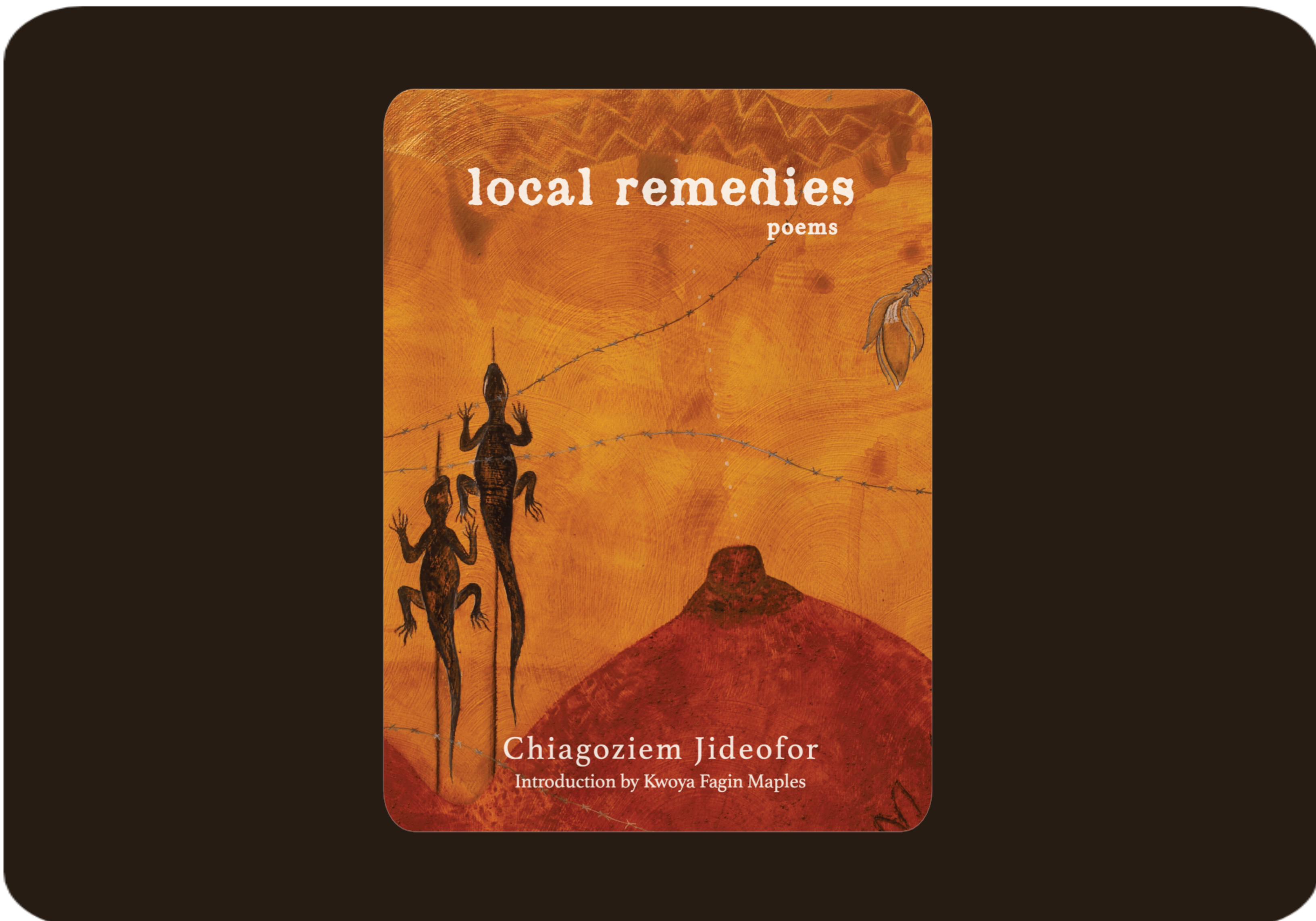
local remedies
by Chiagoziem Jideofor
Host Publications 2026, 106 pp., $20.00
The first literary story I wrote was a historical reckoning or what Sakiru Adebayo terms as fiction of memory in his book, Continuous Pasts, where he examines the postconflict fiction of memory in Africa, in particular the Biafran war. The academic staff union of Nigerian universities (ASUU) strike of July 2013 had dragged on longer than expected. Although it was my first strike as a freshman heading into the second semester, there was enough historical evidence—of other university strikes—that our hope for a quick resumption was foolish. Perhaps, it was the same misplaced expectation that Yakubu Gowon, Nigeria’s former military head of state, had when he declared a police action in July 1967 against Biafra after the latter seceded from the newly independent Nigeria rocked by deadly coups and ethnic pogrom of the Igbo people in northern Nigeria. The strike, though, would not end until December 2013, a whole five months later.
This protracted shutdown of universities meant that I had time for reverie or to revisit an issue of national memory or crisis. By the time I was done with the novel, the scale of the original imagination had simply gotten out of my hands. But imagination alone does not explain my decision to write a story about the civil war where at least two million Biafrans were murdered by Nigeria through a policy of ruthless blockade and starvation. The story itself was set in Biafra and all its characters were Igbo. I am Yoruba. So what was my stake in writing a narrative—a fictional one at that—about a war of brutality against the Igbo people? Although Nigeria was preparing to convene the 2014 national conference on the future and structure of the nation, I feared that a clear artistic rationale was missing in hindsight.
Thirteen years later, Chiagoziem Jideofor’s capacious imaginative world in her debut poetry collection local remedies will help me to come closer to what gets missing when we contend with our collective memory. In the opening poem, “singular voice as us”, the poem draws a circle on the ground with the ǹzù and invites us all to enter this collective space where there is no hierarchy or ego; where the collective memory of the Nigerian civil war is but a backdrop, a costly interruption in this harmonious procession of our lives. The poem archives all the peoples that would belong to this re-imagination of memory like the rolling credits of a cast to a play where when “one falls, the other digs / while one digs, the other prepares to seed”. Through the use of anaphora, the speaker lists all “the ones” although these characters have no names or affiliations.
Yet, Jideofor’s speakers are very wise in their synthesis of personhood and collectivity in a poem that sets the mood and thesis for the rest of the collection. The speaker does not pretend that all there is to life is the wishful-thinking, playacting world of children, their harmless hubris, and mimesis of a kingdom that can only be willed into life through dreaming or the psychic unconscious of the spirit children as the one Azaro elicits in Ben Okri’s The Famished Road.
Today, many narratives of nationhood, memory, and personhood in Nigerian poetry always feature children or childhood as if to represent the frustration with the nation’s (nation as a colonial invention and archive) failure to grow into adulthood after independence, which has pushed many of its own children outside to find more competent guardianship. Many prominent poetry collections coming out of Nigeria these days deploy these young characters in ways that adopt the bildungsroman genre in fiction, but used symbolically not to celebrate childhood but to criticize the nation’s suspended progress activated by the colonial regime in which the mind and memory of the colonial subjects and descendants is wiped out, to paraphrase Fanon, and sustained by the new postcolonial reality of brutality by the ruling class.
Indeed, Jideofor’s local remedies firmly inhabits the scope of what makes us human and makes us remember in this brilliant first collection of poems grappling with the afterlives of the Biafran war.
Yet, local remedies does not valorize childhood naively but tries to grapple with its parable—its full existential parabola—for a return to the pre-colonial, to the spirit-world of the unborn, which is a third of the Igbo’s cosmogony on the cycle of birth, death, and the unborn, as revealed in the fourth stanza of the anaphoric formulation of who belongs to this circle as “pregenital & humbling” as in the following stanza:
the ones coming & going with awareness, pregenital & humbling
exposing how conjoined we all are
when looked at, studied by the same face
in stories told by our enemies…
The contradiction is obvious here: the world Jideofor curates is not only the world of the pregenital children; they are only one of them. So, how wide does the circle go? Who is a part of it and who is not? What, in the words of Sakiru Adebayo, is the global framework of the imagination of collective memory, even as we must turn toward regional or localized memories of a tragedy that is the Biafran war which still rears in the secessionist agitation in Southeastern Nigeria today, and in the psyche of its children, one of whom is Jideofor.
The collection artfully marches us through the cosmos of survival and healing as seen in the poem, “in today’s terms,” where its contrapuntal form mobilizes the poem’s force without ignoring the constituting voices that make the whole as the speaker reveals: “it then grew to become war / hence the need to tell it in parts”. More than fifty years later, the story of the brutish war is still told in parts, or not at all; the poem’s contrapuntal form thus encircles from every angle, like a tight military phalanx, this slippery memory and afterlives of the war. Yet, as these voices of the war and their commander in the past and the present agitators for Biafran nationalism encircle and confront the same mnemonic artefact, it slips away, like the aborted dream of Biafran nationhood that still aches as the new boys of the postconflict era ask why “we aren’t dazzling, / so unlike the sun” in the Biafran flag.
local remedies stages a delicate dance between the personal and the collective that local remedies navigates; and family becomes its rehearsal ground as we hear about a brother who dies in a flood in “mythmaking”, a sister who loves things buried alive in “in abundance”, and roommates whom she pranks and abandons to “sing with beethoven” in the shower in “wild”. The speaker cultivates a wildness that defies space, as the cosmopolitan memory is wont to do, before its violent divisions and re-divisions along national borders. Jideofor’s poetics respects no spatial or temporal borders even when she disavows the exotic privileges of such a position. Indeed it is why the title of the collection is local remedies as if to celebrate the periphery of the dominant imagination, memory, and narrative. Although nothing can ever start clean as we hear in “after the storm when a white dove appears” in any private imagination, the collection often returns us to our essential differences even in the family as we see in “in abundance” where food preferences separate her from her sibling who loves “yam slathered in heated palm”. Even this food combination is atomized into its parts. The palm oil is heated, primed as if for a burn.
On a closer look, the line hearkens to the popular Igbo belief in the proverb (translated by Chinua Achebe in Things Fall Apart) that says “proverbs are the palm-oil with which words are eaten.” History is dry, dead, and rote like things buried and uprooted; it is the literary imagination that brings it to life. Initially Jideofor disavows both memory and its imagination, but she cannot help herself to slather: one thing with another which comes with a risk of depersonalizing or subjugating the other, but she’s a master of the call and response which creates harmony among disparate voices even when the self is stubborn as in “self-preservation” where the speaker hides and seeks part of her self in its “tragic container”. When one self and rhetorical agent slathers over another as in “in abundance”, one part goes fugitive, wild and impermeable as indicated in the next poem, “wild”, which is then followed by return to the whole as in “call and response”. The eponymous poem, “local remedies” is not only an inventory of objects and actions that remedy a harm that is not named, but at each level of the entry, we have the interaction of disparate parts such as the chekeleke (white egret) song which depends on the rain storm and the children waving back; the salt and the tongue; the fence of gmelina trees blocking the sun and so on in the following stanzas:
like the chekeleke song after it rains
like salt for licking
like prayers and hymns
like a fence of gmelina trees blocking the sun
like the plosives in a name
like molding yours into a morsel
like seasonal migration
like going back to wherever one is welcomed
In that complicated image, the gmelina trees provide shade and remedy against a fierce sun, yet it absorbs the latter until it loses personality. Yet, it is this absorption that keeps the tree alive and helps in its ability to make food through photosynthesis. Interestingly, the same tree blocks the image of the sun on the Biafran flag which we see in “in today’s terms” where the poet persona(e)
stay worrying the boys asking
why we aren’t yet dazzling, so unlike the sun in our flag
It is not clear what the tree offers positively to the sun in return, but what Jideofor reveals in this collection is the surprising insight that the cure is its own poison and vice versa as the heavy rain in the first line is remedied by the song of the cattle egret in flight, which reminds us of the transience or seasonality of everything, of essence itself.
In a collection about a history that has been told over and over again, that has repeated itself over and over again in our national life, Jideofor brings novelty to the austere reality of war and creates an alternative to the false surfeit of the archive through a retelling of the psyche, which predates experience (as argued by Carl Jung) itself by re-imagining different artefacts that combine together through conflict, first and harmony later. These include wild persimmons, bone (as in “self-portrait as bone in three lives”), spectral objects as the hauntings of the artist in “persona poem”, and so on. The psyche is primal like hunger, which can only be known, sated in parts but never as a whole as long as we are alive and fervent like children. local remedies teaches us that in a world that is getting more averse to the permissive imagination (and national imagination as in Nigeria), poetry can help bring us together even where the lyric “i” seeks its own spectacle.