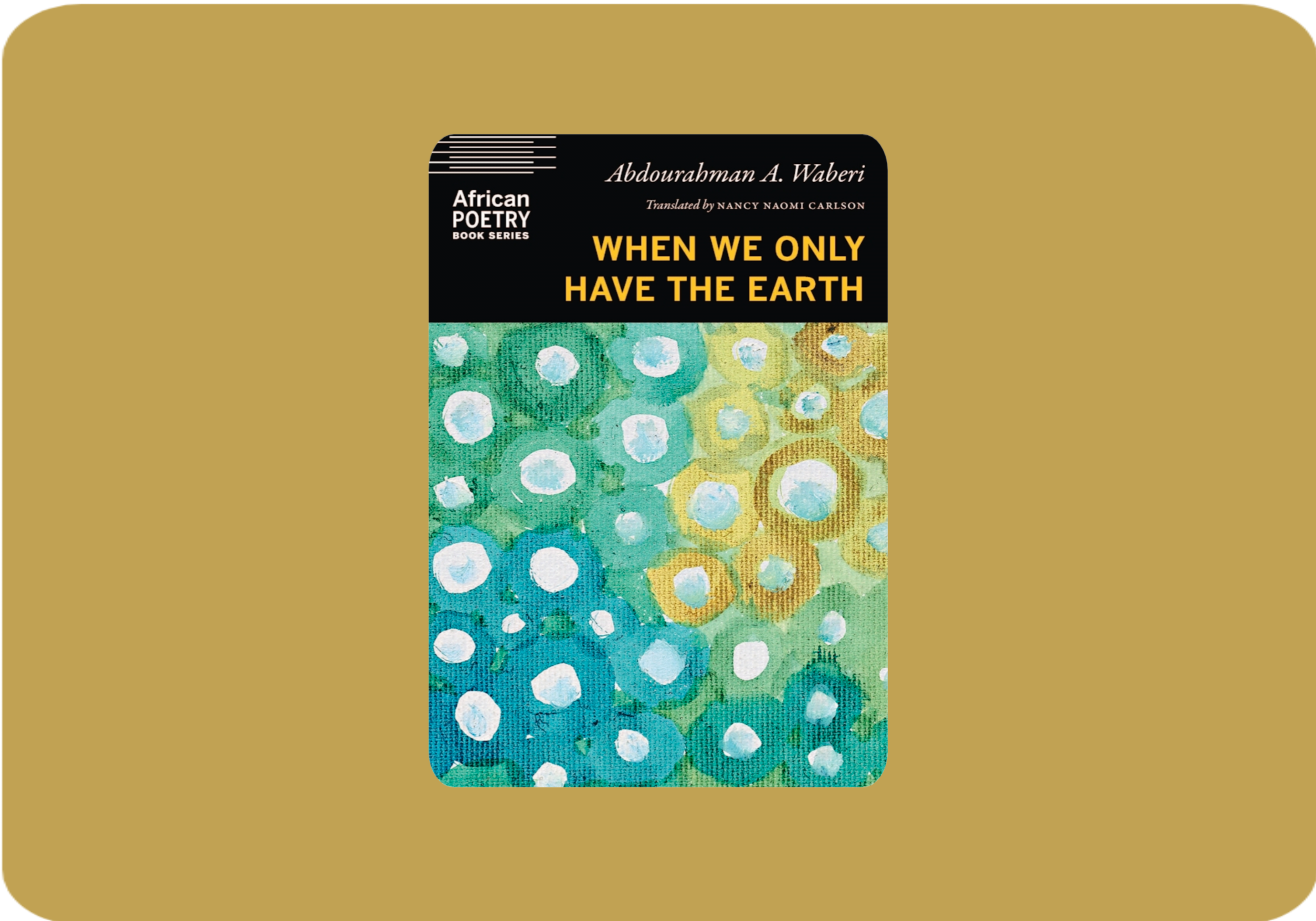
When We Only Have the Earth by Abdourahman A. Waberi
It is extreme how far some people will go to defend the environment. There are believers, whom we often call radicals, like that populating our worlds of the real and the fictional. In the brilliant American critic David Schurman Wallace’s hefty essay about ecoterror in fiction and film called “Abbey’s Road,” suicide bombing or self-sacrificial violence, assassination, extensive sabotage, and destruction of infrastructure are not too far off the mark of what is acceptable to make the world green again. And the late Luxembourgian-American poet Pierre Joris, in one of the most exciting poems I have read over the past couple of years called “On September 14th, Dante’s Death Day,” would see “the trees,” “the air,” and “the sea” rejoice in our disappearance as a species just because we take and take and take, interfering with the proper development of our planet. So would the magnificently talented yet largely unread Stanley Burnshaw in “End of the Flower-World”:
Flourish again, mindless of the people,
The strange ones now on a leafless earth
Who seem to have no care for things in blossom.
Fear no more for trees, but mourn instead
The children of these strange, sad men: their hearts
Will hear no music but the song of death.
However, Abdourahman A. Waberi’s When We Only Have the Earth has another approach beyond the total annihilation of “homo sap sap” (Joris’s term) favored by many radical thinkers and ardent believers in returning the flora and fauna to their pristine state—an approach which many of them won’t be too cool about. The approach is no less terrifying, and at least as Dantean: he urges us to love our planet, perhaps hoping, as Nancy Naomi Carlson, the translator of the collection from French, that the love will be so powerful and “contagious” as to become the force that restores it to its primordial state just as love powers the energies of the Spheres of Heaven in Paradiso. While our living large in the world is both disruptive to and violating of our planet, for Waberi as for Joris and Burnshaw, the solution, according to the former, is not to wish us extinct, but still living yet grown more civilized and aware that we are the ones who need the planet and not the other way around. This is what the poem “Every Being Is Unique” announces, at the beginning of its second stanza, with the quiet force of a theological reversal: “Heaven is on earth and nowhere else / Through strange reasoning we refuse to welcome it.”
The last thing we can accuse Waberi of is naivety because he is more than aware of the damage already done to that heaven on earth. “The world is dying,” he writes in “Sahel! Sa(y) Hel(lo).” He is, in other words, as eschatological as anyone else with the same sensitivity for the environment. But when he stares into the same abyss as Joris and Burnshaw, among others that have done the same in poetry and in life through environmental advocacy and activism, he chooses love rather than the erasure of our species. He chooses for us to remain in the world and he chooses for us to change. In “Hairless Stumps,” he brings the imperative outward to the earth itself and, by extension, presumes our willingness in the grand ecological restorative project, for the planet to “Return to us storms, bees, and earthworms / Allow us / To take it all in, to take life seriously.”
In this light, we are continuous with the interior life of the earth as opposed to loving it from outside: “I am love / Its sigh and its sorrow / I am its tomorrow.” It is an ambitious idea, isn’t it?, if not a strictly impossible one, to suggest that the best way out is the simplest one, which is simply loving the planet in this case. It is an idea we can notch up or down to many reductive interpretations, but the poet clamor about it too many times throughout this collection of poems for us to know that he is nothing but dead serious about the whole affair as everyone else must be if we, and the planet, should have any hope of surviving our ultraconsumptive age.