bright sorrow by Jonathan Chan
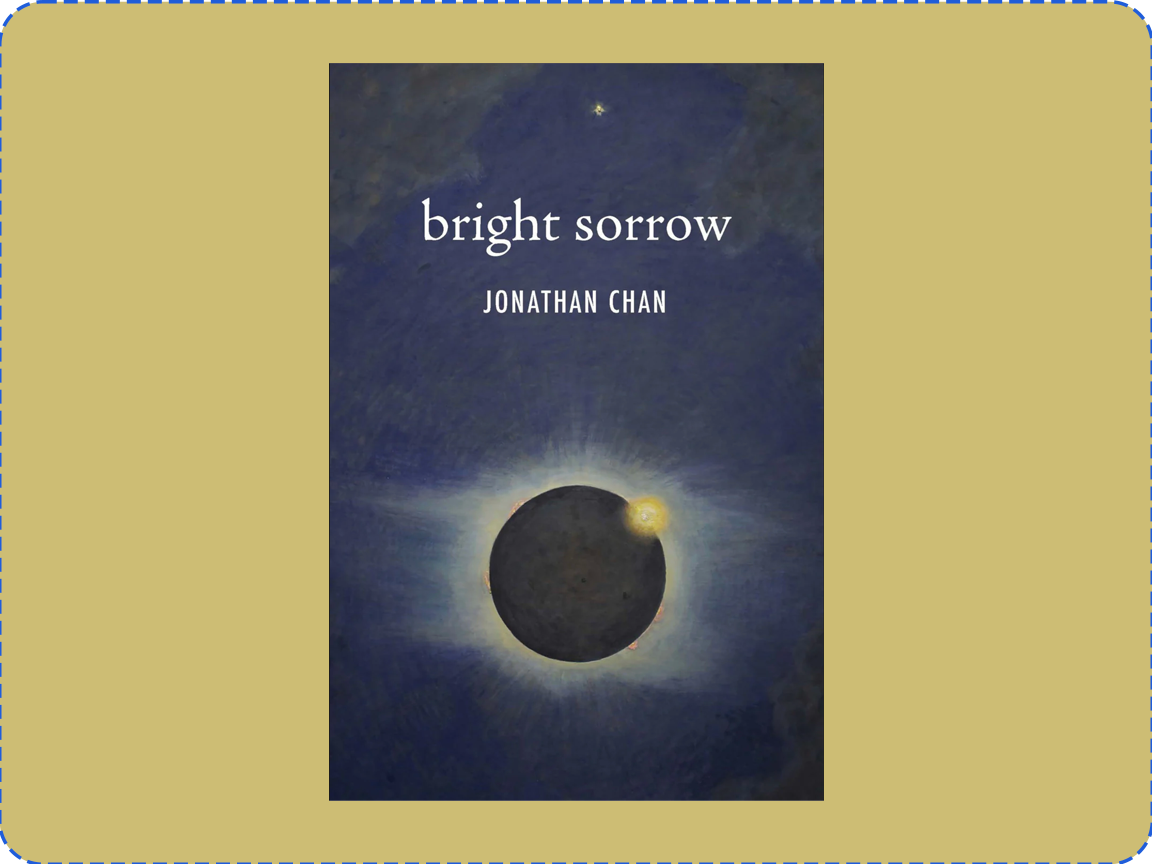
The paradoxical essence of Jonathan Chan’s bright sorrow is rooted in the Eastern Orthodoxy idea of “charmolypê” which, according to the archpriest and theologian Fr. John Breck, is “variously translated [as] ‘bitter joy,’ ‘joyful mourning,’ or ’affliction that leads to joy.” Spanning over seventy poems, the collection is organized into four sections, namely Continuity, Theology, Eschatology, and Possibility through which the poem circle the same site of certain preoccupations from different altitudes with each pass revealing new pressure. A poet of distributed yet composed attention, Chan is someone for whom the devotional and the documentary inhabit the same space, and who trusts that a mangrove root, a bag of baccarat chips, a quota of refugees, a death penalty petition, and the murmur of an Enya melody can each bear equal theological weight. I mean, how interesting is that? In Chan’s imagination, there is no ongoing negotiations between the sacred and the secular; the line between both, in the course of the book, has been dissolved.
The first poem to signal the kind of poet Chan is comes from the first section, Continuity, and is titled “love (ii).” The poem unfolds in plain, lowercased lines whereby their quietness, spawned as much from the lexicon as from the emotions they portray, is a species of formal argument:
i seal my commitment
in ash,
where lies the simplicity
of a first love. it is
disarming,
to feel love thrown on you
like a shawl, swaddled
around a body
shivering, to feel it lick
the cavity of your chest
like a flame, to know
that it lasts the entire
duration of dust. it is the
hand that clenches the other
that can bear up no more.
it is the exhalation
that comes with the first break
of mercy. it is the head
surfacing from the engulfment
of water. see the forgiveness
that endures in a moat
of lovelessness. watch
the clouds ascending
and descending over a
green mountain ridge.
dream of the exiles
over the plains and the
sands making their way
home. see how severance
can only make an absent love
stronger.
Isn’t it counterintuitive, even paradoxical again, that the pure force or pure energy of love does not diminish in separation but is, if anything, distilled by separation? Love, according to Chan, is passive, unsolicited, it is “thrown on you / like a shawl.” However, it is just as active in its working on the mind because it also “lick[s] / the cavity of your chest / like a flame,” a simile which is intelligent because it is precise: a cavity is a space of loss like a room that has been emptied out, which is now filled with a different sort of presence that pervades the whole body without an end to its soulful invasion in sight. Anchored by a subtle but nonetheless impressive anaphora, “it is,” from the second sentence, the poem prepares the reader, clause by clause, for a claim that would otherwise feel sentimental. By the time Chan reaches “see how severance / can only make an absent love / stronger,” he has proven to understand that form is as much a container for meaning as it is its primary enactment: the line break after “severance” is instructive, but not as instructive as the one that leaves the qualifying and amplifying word “stronger” alone at the end to strike home its power, through technical emphasis, towards an emotional climax.
This simple understanding about the technical enactments of form in the course of a poem as it relates to meaning is what separates bright sorrow from devotional poetry that is merely devoted to its own sincerity. Regarding that, Chan is not in the business of testimony. He is, however, in the harder and more rewarding business of making the texture of faith resonant, even to a reader like me who does not share his mind on the same. This literary evangelism—not the didactic or proselytizing type, but the feeling, merely descriptive kind—finds one of its clearest expressions in “against bitterness,” where the speaker’s interior life and the world’s accumulated suffering share the same breath, and where the poem’s theological composure functions less as an argument but as an atmosphere, a quality of attention that steadies the air around it:
on the day of missed silences, the only word uttered
was for a patch of empty sky. each moment felt
off-center, space filled by a trickle of chatter.
then only the watching, and the waiting, and the
silent inward wailing could suffice. I took it all
in, knowing the final rest that waits beyond
the river, flowing toward the ocean. of which we are
each a drop, yet also are. you, an ocean, and me.
like the sky suddenly becoming full, galaxy laid over
galaxy, supernovas contained, all until the beginning
and the end offer a whisper.
Here, Chan is reaching for a mystical solubility, the dissolution of the individual self into the divine body. Though he begins that work, again, through form; the syntactic compression of “of which we are / each a drop, yet also are” is, at the same time as the line break in between those two lines, conducting the dissolution as the words themselves in association and meaning. Evidently, Chan is at his best when he trusts the poem, especially its formal properties, to do the theological work his instincts for prose might end up over-explaining.
That trust, however, is not always maintained. For example, the expressive density of “prayer (xix),” a long prose poem of tightly clenched clauses, sweeping abstractions, and occasional concrete images, quickly becomes its own opacity in both senses—of being unintelligible and dull. Trying to do too many things at once, the poem meditates on solitude, indexes scripture, catalogues sensory experience, and edges towards an apophatic theology. It edges all right, but with effort the reader must share in a way that is considerably less than pleasurable.
An argument might be made that this is also a sensation poetry must sometimes elicit. True, but that’s until we discover that Chan’s sensibility is most at home, comfortably and rewardingly so, in the lyric fragment as in “with the death penalty,” a poem of terminal repetitions, where each iteration of “last” stands, rather beautifully, against narrative coherence to achieve the highest emotional resonance about this dreaded reality to which the closest most of us will ever get is this poem: “last meal. last hand against / glass. last approval. last proof / of vaccination. last pat down. / last letters written on a slip.”; the charged or clarified image as in “garlands,” where a single object (the garlands) is rendered with such patience and discipline, both technical and poetic, that it opens outward, in just three wildly irregular sentences, into devotion, mortality, and beauty simultaneously: “…petals laced in / the tightest bunch, ready / to be lain to meet a / wish, to sate a god, an / offering for a famished / soul”; and the moment of concentrated attention as in “precipice”: “when confronted by beauty, / how could we forget the souls of the dead?”
The whole poem is a preparation for this question, and a good and well-done preparation at that. Chan spends the body of “precipice” talking about his experience, alongside others (the governing pronoun of the poem is “we”), standing and peering over a precipice, “overlooking the rolling greens,” watching the fantails hopping from branch to path, watching the ink-solid sky, dancing in cool air, and having conversations about “moving homes, selling cars, finding love.” Though the “hills stood uncaring, unchanging,” and quite unaffected by their jumble of emotions and elations, they are nonetheless sublime evidence of a beauty that the living once shared with the dead, which being dead now denies them. By the time we get to the question, its weight has undeniably accumulated in our throat. The lyric fragments, the charged images, and the moments of concentrated attention scattered through bright sorrow are, each of them, the precise conditions under which Chan’s poetic intelligence operates at full force.







.avif)