A Review of Chaotic Good by Isabelle Baafi
Chaos Refined
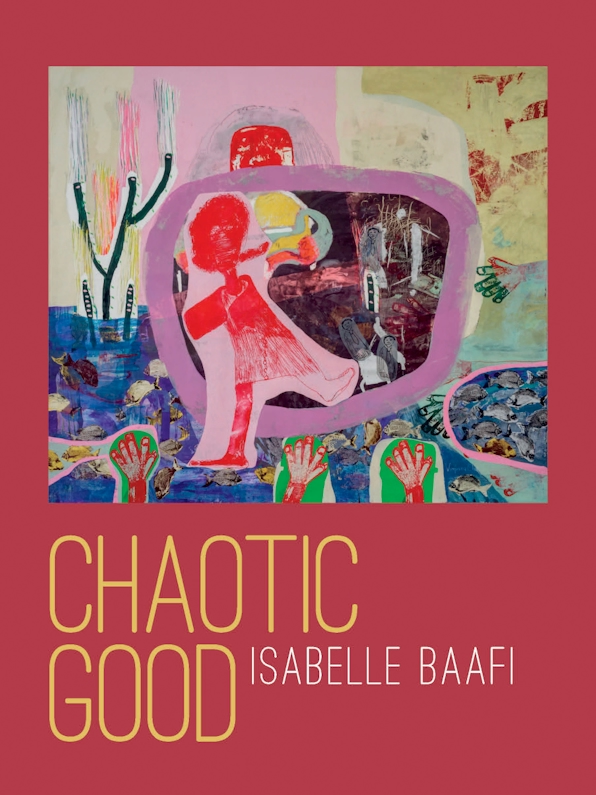
The British poet Isabelle Baafi’s debut collection of poems titled Chaotic Good is nothing less than excellent: divided into five sections of recognizable thematic concerns like ‘Separation’, ‘Childhood’, ‘Adolescence’, ‘Marriage’, and ‘Rebirth’ in that particular order, the collection is raw and uncompromising in its self-seeing, lucid and rigorous in its expression, and majestic in its sweeping craftsmanship. As if the strange registration of its title is not enough, the collection is also headed, as one of its two epigraphs, by the American novelist Zora Neale Hurston’s catchy, learned, metaphoric and now infamous saying from the beginning of the third chapter of her 1937 novel Their Eyes Were Watching God: ‘There are years that ask questions and years that answer.’
Confronted with the effortlessly loaded ingenuity of the statement with its envious clarity as bonus, one immediately imagines Baafi’s book to be the sort of poetic journal that records the interrogative years as intensely as the informative ones, especially since her poetic vision fittingly connects with Hurston’s exploration of the arduous process that goes into self-realization and the journey to articulate one’s understanding of life and love through the life of her novel’s protagonist, Janie Crawford. So, in that simple epigraph, two sides of a single scene are established for Baafi’s book, annealed by the suggestion of her title’s moral flexibility.
The title of each section is suggestive of the emotional registration of its corresponding poems. Nonetheless, the poet succeeds in telling us a simple truth best communicated through discipline, of both thematic integration and form, by having us wonder why she starts at the middle (at conjugal separation rather than childhood): that chronology of events matters less in their poetic reimagination than the way such events are so reimagined and relayed. And so the title, Chaotic Good, itself tells us that true authenticity can be found in choices that defy conventional criteria, societal norms, or even a person’s perceived character. Collectively, the five sections chart a journey of necessary transformation and uneasy self-discovery while committing the challenges of the painful experiences that realise these dual realities to the same focused, delicate scrutiny in her poems that a scrimshander commits to her delicate scrollwork.
The subject of the eponymous prose poem is modern: funny, compassionate and emotionally assimilating, the speaker catches one of her married friends in a tetchy situation: she’s dancing in a club with someone who is not her husband:
Friend, that wasn’t you last night at the cinema – the one with sticky floors and seats that smell like nachos and cum. You would never be caught dead there. You always said that your laugh became a shriek in the dark: people forget themselves when no one’s looking. As for me, I notice more. You cross your ankles when you sit, even on the bus. As quiet as a boiler’s hum, milk-sore and motherly. Faithful even to the ammonia in your cloth, peeling you back. And so I know it wasn’t you at the cinema, in the lobby, wearing the bob wig I lent you.
It is implicit in the speaker’s evasive tone that her friend’s behavior not only challenges but shatters conventional definitions of good, connubial conduct to bits. However, the accommodating tone is justified, especially when the speaker infers how frustrated her friend must have been in love. This is where the implication that true well-being, authenticity and personal ‘good’ can sometimes be found in culturally chaotic actions, springs from: often, ethical certainties dissolve under emotional pressure. Like a frustrated married woman finding an alternative arm to wrestle the sort of love she thinks she deserves—an action as primordial as shopping is modern:
Your cleavage spilling out of the blue dress that you fingered when we went shopping and called so trashy with a smirk. How could it have been you? The way he stood over you, his hand squeezing your waist as you threw back your head to laugh, his eyes plumbing the depths of your throat. How engorged your tongue must have been. How wet. How you never knew it could be. When we were thirteen, we saw a man fasten his girlfriend’s seatbelt and you said, I want to be loved just like that.
Her adult reality disappoints her childhood dream; such display of affection is neither universal nor as easy as fastening each other’s seatbelts. The speaker understands this as much as she does the heart’s need for good loving and so reads personal satisfaction or fulfilment as a justification for disrupting the mores of marriage. In the grand cultural (quite illiberal) scheme of things, this is a bit simplistic, although that is least of what the poem, taken alone, will have us think. But the speaker’s memories and experiences informing her composed air to such strong disloyalty witnessed from her friend are as, if not more, important as her understanding of the need for self-satisfaction. In ‘The Maelstrom’, a poem that comes immediately after ‘Chaotic Good’ and starts as though it is its situational continuation, the speaker, a complete opposite of her cheating friend, is having a terrible fight with her own husband:
And after in the kitchen, crouched like dogs abundant with shit,
we sweep shards of frosted glass into the dustpan’s horrified mouth.
You would’ve caught the vase if you’d seen it was the wedding gift
from your ex. And I would’ve thrown it harder if I’d known
you wouldn’t duck. Silence blisters, then it breaks. At our antipode
two currents collide. Twist each other in a dance they cannot quit.
The speaker is composed about her friend’s less than adherent actions because she understands the toll, sadness and trauma that come with the emotional turbulence in her own marriage. She understands, but without having as much confidence or independence of self as her friend to go in search of her own self-satisfaction in another’s arms, which is the reason why she’s free of judgements, even those confirmed by cultural inclinations.
Meanwhile, these visceral, unbuttoned outbursts about marriage and its miserable participants hardly touch the midpoint of Baafi’s expressive power. Her best poems are featured in the first three sections: ‘Separation’, ‘Childhood’ and ‘Adolescence.’ ‘Sigma’, with its wrecking note of self-abnegation and the desperate plea for validation in the face of consuming love, exhibits the raw, often paradoxical, complexities of self-identity: ‘I gave everything / just to brush against your feet // To twist against the fall / and not ask how.’ And in ‘Ouroburos’, which is a masterpiece, Baafi subscribes to the sensible notion that a 21st century book must feature, in both linguistic texture and artistic verve, 21st century phenomenons, which in this case is cybersex:
The chatroom is a children’s sandbox
pulsating with snakes. Every now
and then the graphics spasm, sparkles
flashing us. Messages poke out
from the hem of the screen.
Some thirsts should not be quenched.
But here, at least, my 14/f/ldn is everything.
The poem is crucially aware of the sickening and destructive nature of sexual addiction, the way it presents itself in the more glamorous apparel of connection. Unable to satiate the heart-deep emptiness within, addiction instead fires up the speaker’s destructive need that gorges the self out of its full and weighted shell of being human and true, and turned her over totally to or as an object of pleasure:
I can’t not do this.
Hunger made me; carved me in its image:
hands with which to touch, touch, and a tongue to taste, and a belly –
his – in which to bury myself.
Hunger made me do it: seasoning
my pubescent veal, my fatty flesh
and oil-brushed hips, my raw hide
marinated in red lace and violet glitter,
the skin around my eyebrows
sore and bumpy, freshly tweezed.
Although impressive in their harmonious articulation of the attendant struggles that come with the time in which we are living, especially about love and the self, the poems register as imaginatively strong, poetically alive, and pleasurably perdurable because the reminiscences are visceral and the expressions of them in verse are gutting, and quite appropriately so. But what makes these visceral reminiscences and gutting expressions objects of beauty is Baafi’s vocational understanding that having visceral and gutting stories are never enough tools for the serious poet that wants to touch the reader’s brain and heart. So, she drafts that vocational understanding and conscribes it to arrest the formally surgical.
Many of the poems are written in one of the newer poetic forms or the other. The poem that opens the book ‘The Mpemba Effect’—one of the five introductory poems to the sections (the others are: ‘The Kuleshov Effect’, ‘The Bystander Effect’, ‘The Horizon Effect’, and ‘The Butterfly Effect’)—is written in an inverted form where the lines of the first stanza are repeated verbatim in the second but starting and read from the last line to the first (vide Theresa Lola’s ‘Carousel of Oil Sheen’ from Ceremony for the Nameless). While the first stanza of ‘The Mpemba Effect’ suggests the thrilling intensity that characterizes new marriages, the second stanza, now inverted, shows how quickly such hot intensity turns cold, giving an interpretive nod to its scientific title. The following are the lines of the first and second stanza of the poem, except the lines for the second has to be read in an ascending order:
A husband, a wife. Consumed by all we hungered for.
You, the dominant taste in every bite, and I came in raw,
I was humble. I learned the right things for the wrong reasons:
sweating over a pot for days, tasting myself in wilting leaves and
light soup: gizzard, liver, tomatoes, chilli.
I never hated anything so much. Not
you, the meal. I couldn’t stand
anyone but you. Waking up each day to
the soft press of your lips on mine as you left. Seeking
abandonments sweet enough to crave.
There are
more species of apple than human taste buds with which to enjoy them.
Give me a portion that will not open my eyes. Give me more.
Not the food – us.
Nothing ever spoiled so fast.
By our seventh year we ate around the rot.
At a time when almost every attempt at writing in newly invented forms has shown nothing less than the half-assed energy brought to them by the poets so moved to try their hands, Baafi also flexes her technical craftsmanship in her golden shovel poems. Golden shovel is a poetic form invented in the late 2010s by the American poet Terrance Hayes as a tribute to Gwendolyn Brooks in a poem of the same name. The form works, according to the former editor of Poetry Magazine Don Share, by taking the last words of its own lines ‘from a line or lines taken often, but not invariably,’ from another poem. In Baafi’s most representative and impressive case, the precursor piece for the expression of her technical dazzle in ‘Reader, I Married Him’ is a 1973 song about love and shattered dreams by Gladys Knight & the Pips titled ‘Midnight Train to Georgia.’ The line she uses—which implies the sort of intense love articulated in ‘The Horizon Effect’: ‘O first love, / blessed and cursed love, / shelter me under your heel.’—is from the chorus which goes: ‘I’d rather live in his world / Than live without him in mine.’
Although Share concludes that ‘[t]he results of this technique can be quite different in subject, tone, and texture from the source poem, depending upon the ingenuity and imagination of the poet who undertakes to compose one,’ Baafi’s poem is just a little bit different from the song by going just a little bit further in intensity through her hyperbolic diction. The poem plays out a gorgeous craze of a mind zonked out by love, relaying, with unrestrained evocation, pathetic self-effacement as a result of a fractured sense of self, a botched suicide that filled the speaker with a new, quite refreshing sense of life, and the recalibrating force of good, intense lovemaking:
If you asked me why I made myself so small, I’d
show you the river; the one that would rather
gorge itself on sewage than be clean. I’d give you a toe to live
upon, a rotten tree to kneel before, a dustpan to curl up in,
a name pried from a ghost. My laughter was thin, but his
gave all the birds a breath to glide on. Remedy for a wretched world.
I was never that attached to me anyway. Never more than
a ribbon’s stretch away from curling against a blade. I once put a live
wire on my tongue to taste the void. It was not without
its sweetness. That sleep – like choking on feathers, like him:
the place where women went to die. The way he fucked me in
front of the mirror, so I’d know that the face beneath him was mine.
In cases like this, Baafi trades sentimentality for disciplined expressiveness and we are all gratuitously rewarded for it. Gratuitously not because the poet has no business considering the reader’s emotion; foresight like this is only preceded by that writerly consideration. Rather, the reward is gratuitous because we are saved the pitiful spoon-feeding of easy sentiments without the ravishing edge guaranteed by a purposeful language: the stories ask questions that the forms are only too eager to answer with grace. Holistically speaking, Chaotic Good is a book about transformation, and no other poem shows, in one scoop, the far-reaching, if sometimes niche, scope of that transformation than this golden shovel.







.avif)