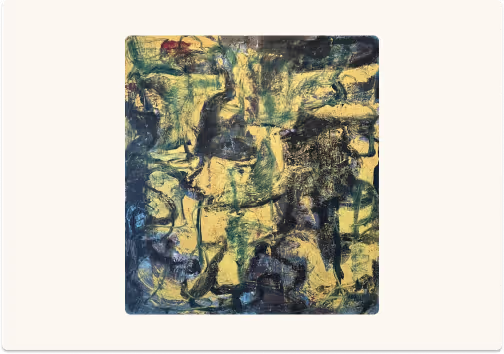
Whatever You Want
%20by%20Maruja%20Mallo%20(1926).png)
Hunched over my desk in our dirty apartment, senior year of college, I flipped through the marked-up sheaf of poems again. Each had more crossed-out lines than spared ones. The lines looked like horizontal bars across a once-wide window.
When they first came, just a few years before, poems flowed through me without effort and without end—dozens, scores, hundreds. Now, I second-guessed every line, every image. Nothing seemed right. Nothing seemed alive.
I looked up at the window in front of my desk, seeking escape. Against the pane, the night crowded in. All I could see was the shadow of my own face, tension crowding around my eyes.
I crumpled the paper and slammed it against the desk.
When the first poems had come, they’d been like birds migrating through my waiting brain, their floating music. All I had to do was tilt toward the birds as they flew through the ink and across the page. Now the poems were nothing but dead ink.
Amy had been right.
I opened the desk and pulled out her letter that had arrived last week. I held it to my nose, inhaling the sage scent from the leaves scattered inside. Just a few months before, she’d completed her poetry thesis with Professor Robert Cording and gave an entrancing poetry reading. Halfway into the first poem, she’d paused, said a line twice, and then a shadow passed over her, and she drifted to the floor. It was a legitimate, real-life, balletic, twentieth century swoon. A few moments later, after someone got her some juice, she insisted on continuing. We’d all leaned in, locked on every word. She could have read the phone book and I would have found it fascinating.
We started writing letters to each other that summer, and as she left for Pine Ridge, South Dakota to teach at Red Cloud Indian School, she wrote to wish me luck on my senior thesis.
“I didn’t realize until after the first month,” she said, “that I’d be disturbed by my thesis. It disturbed me half the time.”
Now I knew what she meant.
Before, poetry for me had been a secret thing, a fugitive home. Now it was something official and academic, the final step in the honors program. It was work.
Earlier that day, Professor Cording had handed back my batch of poems with his marks. The critiques dismayed me. In addition to crossed-out lines, he’d sometimes write alternative versions at the side of the page. I remembered, years before, my junior high art teacher had taken her brush to my painted tree, working out the dappling of light against the bough. When she was done, it took everything I had to not throw it out the window. Poetry, I’d thought, was one of the only places I felt free. But now these poems were neither mine nor a place of freedom.
Thumbing through the poems again, I burned in my own self-questioning, and Cording’s words just added kindling. I felt like I was knocking on a wall in a black room, unable to find a door out. Like that window, with the night and my own tired eyes pressing in.
I hadn’t thought that this year would go this way.
From the time I took his course as a freshman, I was in awe of Cording. He’d come to class with books stacked under his arm and sit down at a regular desk. Folding up his flannel sleeves to his elbow, he’d open the text. He’d guide us through a poem as if it were a cathedral. Room by room, stanza by stanza, it would rise up before us in the classroom. His hazel eyes would look at the poem, then gaze at all of us, trying to read us as he talked through the intricacies of each line, each new window in that cathedral. We’d be lucky to get through two poems per class.
He was shorter than I was, but I always felt like I looked at him from below. He didn’t have to stand at a podium to have my full attention. He’d pass his fingers through his thick brown hair, trying to find the words that might reach us.
A poem wasn’t magic, but a shimmering place we had before us. Maybe not a cathedral. One of those houses that we visit in dreams that feels like our own but suddenly has rooms we never knew existed. Maybe that’s why his flannel shirts, which seemed more lumberjack or carpenter, seemed right. Even if he occasionally wore an oxford, he’d have those sleeves up in no time.
Sometimes he’d gloss a line with some intimate part of his own life. Exploring “Fire and Ice,” Cording talked about desire—how in spring, even a slight glimpse of short sleeves or a skirt kindles desire. I was entranced. He did not seem to feel the shame that I felt, as I tried to keep my eyes averted from my classmates’ beauty. He named that feeling as human, not creepy or freakish.
Poems, for him, were not machines made with words or specimens to be dissected, but living dwellings that demanded we bring our whole lives to them. Even Frost, who always seemed like an irascible yankee caricature to me, became a guy who wondered, in dark winter woods, about escaping his life—maybe even ending it. He wasn’t some celebrated poet anymore, but a person who suffered. Every poem, in Cording’s reading, suddenly felt like it could really be about me—or better, about all of us. I wanted to read like that. I wanted to write like that. I wanted to be like that.
Yet re-reading draft after draft of “Demand,” a poem that I’d written about encountering a homeless man, I felt farther than ever from being that kind of writer. That kind of person.
The truth is that I wanted not only to be a writer. I wanted to please him. Those cross-outs, those rewrites, those notes at the bottom said that I was failing.
I put Amy’s letter back in the envelope and into the desk. No one else was in the apartment, so I had no one and nowhere to go for distraction. I leaned on the back two legs of my chair and turned my gaze to the massive poster of the album Zen Arcade on my wall above my bed. I pretended for a moment that I was in Hüsker Dü, wandering that rainbow-colored junkyard with my fellow bandmates in our long coats, searching for something, not knowing what. Searching a painted junkyard saturated with pastels seemed exactly like the band’s aesthetic—turning castoff trash into something both battered and beautiful. Their postpunk music gave melody to the pain that would sometimes overcome me—the pain of uncertainty, anxiety, and fear that, despite everything, would overwhelm me when I was alone.
I pressed open the CD player, placed the disc onto the cradle, and fed it back into the boombox. My scalp prickled with heat and blood, as I sang alongside by Bob Mould:
He lives in his imagination with those friends of his very own
He doesn't get along with the outside world, he'd rather be alone
Sometimes when it's late at night, he starts to wonder why
The plans he made can never happen so all he does is cry.
Between the verses, Mould slashed up and down the guitar with his left hand, as if trying to break it open. It was a song about a boy like me, a sensitive, obedient boy who found life impossible, caught between his dutiful and dreaming natures.
Whatever you want. Whatever you do. Wherever you go. Whatever you say, Mould sings in the chorus, a numbed monotone, and in the outro, his voice caterwauling around me.
I wanted to please Cording like I’d pleased my parents growing up. But in trying to please him, I and my writing seemed farther than ever from who I thought I was, or was trying to be.
My despair that year wasn’t just in my difficulty writing poems, though that was bad enough. I’d also had a series of failed first dates, and failed asking outs. Even Amy was safely in the friendzone, at least officially, a couple thousand miles away. To top it off, graduation was nine months away, and I had no job on the horizon, no idea what was next.
Yet when I listened to punk music like Hüsker Dü something cracked open inside me. Even while singing of depression and anger and grief, lead singer Bob Mould found a way to turn that raw ache or blistering agony into something almost beautiful.
If it wasn’t beautiful, it was, suddenly, something that could be lived through. The way Rilke did, in Letters to a Young Poet, in response to Kappus’s angst, counseling patience: “Do not now seek the answers, which cannot be given you because you would not be able to live them. And the point is, to live everything. Live the questions now. Perhaps you will then gradually, without noticing it, live along some distant day into the answer.”
This idea of living the question flooded me with relief. Maybe I didn’t need to have all the answers. I just needed to be patient. Patient, from the Latin, means one who is suffering.
Rilke’s idea, of course, rhymed with John Keats’s “negative capability”—that capacity “to live amid uncertainties without irritably reaching after fact and reason—and Hüsker Dü’s “Games”: “Just when you think that all your answers are so right / You'll fade away and disappear from sight.”
Even if my poems would not come, I was finding sympathetic synchronicites. It didn’t matter that one was a postpunk rocker from Minneapolis, another a consumptive London poet living in Hampstead, and a third, a lonely Bohemian writing in German—they were exploring the same fog-bound psychic terrain. How the place of questions, the opening of uncertainty, was not a place to flee from, but an unknown dimension to explore.
The opposite of that was absolute certainty—where everything was already decided, and nothing could be discovered. Like writing a poem whose meaning was already known, whose final line was already written. A dead letter with no address or addressee. That didn’t make the rocky, misty terrain of uncertainty any clearer or easier to navigate.
I questioned myself even as I tried to live the questions. I still do.
The next day, I creaked down O’Kane hallway to knock on Cording’s door. It was open,
Cording behind his desk.
“Hey,” I said, sitting down, my loaded backpack still over my shoulders.
“It’s hard, isn’t it?” he said. He could tell I was suffering. I wore it all over me, my own
foul existential cologne.
Then he smiled. He almost never smiled in class. He was so serious—about the words of each poem, about watching us work our way through. That’s why I remember the smile.
I nodded, barely keeping my shit together. Afraid of my tears.
“I think I was trying to get you to write like me,” he said. “Don’t worry about the story you want to tell. Just take it word by word. Line by line.”
I understood the words, but not their meaning. My face showed my confusion.
He smiled again, a smile that leaked pain at the corners.
He said, “Stay close to the language. Let it lead you. The poem will work its way out.”
That night, back at the desk, I opened my notebook again. I didn’t know how else to proceed, except with a blank page.
I paced the bedroom, and then out into our kitchen, the music bleeding out of the room behind me.
I had no idea where this poem was going. Where I was going.
But it was clear that Cording believed I could get there. I didn’t know if I would ever be able to please him. But maybe that wasn’t the point either.
Looking out at the Worcester traffic below, I wondered if I could stand right there, in the cloudy turbulence of my unknowing, if I could stitch one word after another and find that they fit together, maybe—even years later—I could arrive precisely where I was.




.png)
.png)
.png)
.avif)