
Pedagogy of the Maimed but Luminous
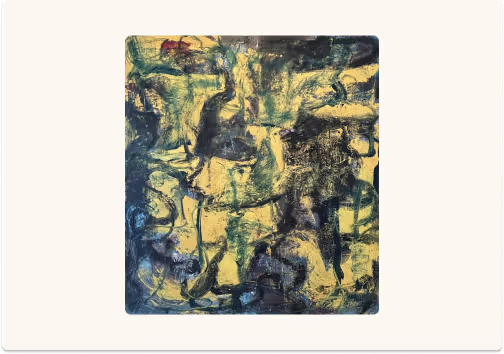
One of the most important moments in Nigerian history began on 6 July 1967 until 15 January 1970. In the two years, six months, one week, and two days of the Nigerian Civil War, over one hundred thousand combatants were killed. During the naval blockade, the Biafran bloc lost over two million lives to famine and more than four million people were displaced at its end, all of which makes the war one of the bloodiest, most devastating, and culturally catastrophic incidents in modern African history: from ethnic divisions, mass displacement to disruption of traditions. These are the facts of the war. But the Nigerian poet Chiwenite Onyekwelu, returning back (from such poems as “Screenplay” and “in narrating biafra war”) to the subject of war and its resulting atrocities in his poem “Lute Man,” published in The Hudson Review, offers something outside numerical objectivity and statistics, and reaches to the core of the human spirit itself. In fifty-four lines of eighteen uneven, tonally varied tercets, Onyekwelu’s formal awareness is impressively at work to unpack the strange combination of the human conditions in the aftermath of war and trauma: from pain, disfigurement, resilience, to the enunciation of beauty.
The poem reminds one of Ocean Vuong’s early poem called “Song on the Subway,” especially in the image of the boys in the former waving the lute man from the safety of their school bus as he clutches his proxy for survival, his lute. The main characters in “Song” and “Lute Man” are both long of age, both are physically impaired, and both elect music to be the only incantation against the spell of times lived in pain and despair. However, Chiwenite’s poem is not given to sentimentality in the sense that its motive to feeling, despite the poem grounding itself on the intricate relationship between trauma and beauty, is restrained to simple recollection, absent judgement, absent visceral outbursts. For instance, Vuong’s speaker (who witnesses the “blind man” play his violin) becomes so entranced with the violin note that
I want [to] crawl into the hole in his violin.
I want to sleep there
until my flesh
becomes music.
The speaker of Chiwenite’s poem, by contrast, is not so entranced by the musical note being played as opposed to the lute in combination with the man wielding it, making his awful curiosity the locus of narrative departure against Vuong’s ecstatic surrender. What then emerges from Ken’s curiosity (one of the two boys in the poem) in the course of “Lute Man,” its speaker’s ironic deflection of Ken’s question, and both boys’ paradoxical reaction of pity and awe to the man’s even more paradoxical appearance, is that historical amnesia cannot save the historically ignorant, however young, green, and innocent, from the consequences of history, of which the lute man is a rather exhaustive embodiment:
I remember the silence heavy
as lead & then my
buddy Ken curious as ever,
asked what did I think chopped off those
legs? As if at 14 I knew
anything about the war;
about those villages raided & charred.
About the bombs & each
maimed kid.
In the end of Carl Terver’s “Coming for Your Head” from his chapbook For Girl at Rubicon, Terver sees our popular response as a people to atrocity as rhetorical instead rather than pragmatic: “Moloch’s worshippers make merry while we / submit research papers to Princeton: / The Beautification of the Countryside with Red Flowers.” Conversely in “Lute Man,” Onyekwelu, through his complex characterisation of the man as physically impaired yet an equal aesthete of music, reads the less than pragmatic response to such stark experiences as our human and quite natural way of choosing our own proxy for happiness and beauty. That which Terver implies as inaction or ineffective action to the status quo, Onyekwelu, through his lute man, determines to be a necessity indeed.
For the lute man who, in a considerable sense, stands for us, music is not an inaction. The lute, with its sonorous and soothing sound, stands as a symbol of the same existential significance as Geoffrey Hill’s “wise bird / Of necessity” in “Three Baroque Meditations” and Walt Whitman’s hermit thrush in “When Lilacs Last in the Dooryard Bloom’d” whose freedom to sing is a prerequisite of its continued existence. The lute reifies man’s will to survive and, hence, a representation of our proper execution of the resilience that can be more or less natural, innate, or even manufactured at will. Hence, the poet’s equation of the man’s intimate acquaintance with music with animals that have adapted seemingly effortlessly to survive in harsh environments:
In one
place, an Alaskan wood
frog freezes its body to
survive the winter. In another a kangaroo,
deprived of water,
hydrates on desert seeds.
What makes this poem impressive and sublime is not the grandeur of its subject. Rather, it is impressive and sublime because the execution of its subject is artistically clinical, formally adherent; it marries history not only to imaginative clarity, but also to the endless ambition of poetic language towards a sort of precision enviable even to the most painstaking scrimshander. In the poem, no word is out of place. Nothing is senselessly abridged. The poem is right at home with the stops, pauses, and the punctuated paces, each of which commandeers the reader’s attention not merely to particular words, but also to lines with mild paradoxical overtones, ascertaining, for example, the man’s rousing insistence on beauty and liveliness:
In yet another, this man flourishes on two
chopped feet holds
a lute like something
bright. How—running out of time—he
lived as though capable
of blooming of suspending
time.
The substantive momentum of the story of the Nigerian war narrated in the poem is offered through such recollection as though curled from the unfiltered plain of the imagination. But that’s exactly the work of excellent poetry: the language of the casual in lived memory remastered to the strange versified. And so the most important moment in the poem comes after the twentieth line in which the poet declares the month of his present reminiscence for decisive precision, which is indeed what the knowledge of our history affords us. He says:
It’s August
of that year. I remember the silence heavy
as lead
But, despite the reenactment of the speaker’s encounter with this physically disfigured man—a project of history as devastating as an August hailstorm—“casual” yet horrific as it is, “August” here is neither objective nor loyal to its implication of majesty as it is in smatterings of Wallace Stevens. Rather, it is encumbered with bleakness, circumstances far removed from serenity, affecting the speaker’s psychological stance in which he “could barely pay attention to my teacher / going on & on about / Charles Darwin.” Yet the one affected by their casual encounter is not the handicapped man, who is both pitied and marveled at, but the speaker of the poem simply because the former has his lute, who “lived as though capable / of blooming / of suspending / time.” The speaker and his young friend are so affected, perhaps, because they are ignorant of the man’s history, which is essentially the history of their nation, their own history.
In his Clinical Blues, the Nigerian poet Dami Ajayi writes, rather dejectedly, in the end of a poem called “Amnesia” that “Amnesia is the cure / Administer two milligram stat.” However, Chiwenite Onyekwelu’s “Lute Man,” as though to lift the crestfallen spirit of the precursor poet regarding our passive attitude to history, refuses the dosage; the poem remembers as well as insists. Stunned by the paradoxical image of the consequences of history they were never taught, Onyekwelu’s boys go on wondering about the afterimage of the man, which stays with them, distracting them in class. Indeed, what historical amnesia has taken away from the boys in the ache of memory they would have learned to live with, their chance confrontation with that same history in the image of the man has given back in his total embodiment of how beauty survives trauma. As the poet asks sarcastically, perhaps even bitterly, in the middle of the poem—
What in the name of fruit flies was I
thinking what
drosophila what encounter
had all that science justified?
—if, in the face of such horrendous pasts, education can afford to remain so unmoored from memory. Though they do not receive their history from textbooks, the speaker and his friend Ken receive it in the figure of a man who is both wounded and luminous, who plays his lute as much for survival as for the heck of it. This way, “Lute Man” asserts what Ajayi’s “Amnesia” mourns. Indeed, forgetting may dull the pain of having to deal with the past, but it also denudes us of the recognition, the empathy, and even the resolve to make sense of who we are in the present. For us, Onyekwelu implies, remembering can be instruction enough.







%20by%20Maruja%20Mallo%20(1926).png)
.png)
.png)
.png)
.avif)
%20(1).avif)

