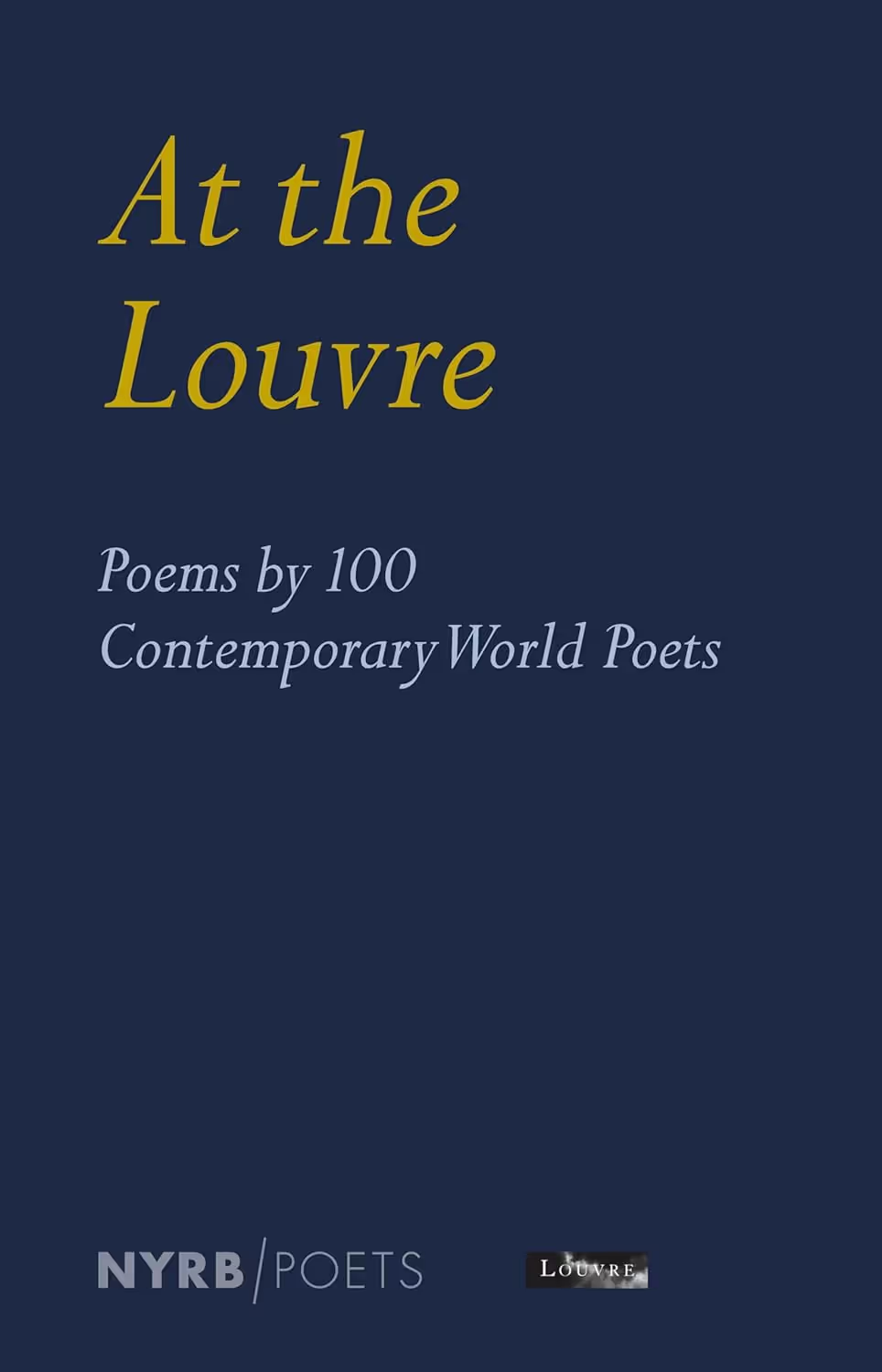
Bantustan Blues by Tjizembua Tjizuku

Getting to Bantustan Blues by Tjizembua Tjizuku in Kumi Na Moja, the 2025 poetry chapbook box set from African Poetry Book Fund, felt like the first days of spring. However, those fresh and peaceable days did not last longer than coming to the meaning of bantustan. According to OED, it means: “(A name given to) a self-governing area in South Africa and South West Africa (now Namibia) designated for a particular Indigenous African people. Also: the policy of establishing separate territories for black citizens.” It’s a linguistic invention that continued the apartheid project of racial exclusion, discrimination, and segregation. On Tjizuku’s hands, the phrase bantustan blues carries the history of resistance of the same people so excluded, discriminated against, and segregated since the blues, in Western poetic tradition, is a paradoxical form of expression. There is an emotional duality to it. According to the African American philosopher and social critic Cornell West, blues is a way of generating an “elegance of earned self-togetherness,” a way to maintain resilience when facing the “calamitous.”
In the same vein as carrying the history of his people, Tjikuzu is questioning the same people’s response to their racist time. He has to question it because that history trickles down, and the poet wonders if resisting through self-singing and “earned togetherness” is enough: “The Timbuktu blues of twilight are not a shield against the rupturing shock waves of history.” They are not because that terrible history still trickles down generations. He wonders still in rhetorical questions that are not so easy to answer otherwise:
If the dead do speak in blues, what are they saying?
Do they wish to comfort us?
If I stare into the twilight long enough, will my dirge turn into a joyous rhapsody?
Is blue the love of ancestors reflected back to us?
If twilight sings, why does my heart droop
like a foxglove heavy with rainwater?
Why this harrowing? Why this howling?
The speaker’s heart is heavy because it is human and more civilised than the hearts of those that separated people based on race, and the harrowing and howling are the results of the kind of brutalities those racialized ancestors had to face in their time. One of the most terrible physiognomies of those brutalities is the Commander and former Governor of German South West Africa Lothar von Trotha, an imperialist as scum-of-the-earth as Cecil Rhodes and Leopold II of Belgium. On October 2, 1904, von Trotha issued the infamous extermination order (Vernichtungsbefehl) which declared that every Herero found within the German border, armed or unarmed, with or without cattle, would be executed. The decree culminated in the escalation of the Herero and Nama genocide, targeting women and children as well as men. But the genocide, according to Tjikuzu, did not stop at killing the people, but also their way of life, particularly their cultural, communal, and historical confidence:
the names of Herero children changed
from Ndundumehi, Karungukongue—
names immovable as mountains in the earth,
as certain as the great paws of a male leopard
striking the red sands—
to accusatory and abstracted names
like Tjiṱa, Tjizembua, Periua, Pepua—
names that hint at the unutterable
like the dent of a bullet
lodged in the muscular flesh of the heart.
—“Names and Warnings”
There are many facets to the consequences of violent histories, Tjikuzu is suggesting. And the facets that we don’t usually talk about because they are not as clean and obvious as numbers and statistics are just as important. They affect generations, and in this particular case, how the next generations are named.
As dour, historically searching, and communal as those poems are, Tjikuzu is just as capable of excavating the personal and the light as play. In “Archispirostreptus Gigas,” “June Bugs,” and “Dog Ode,” Tjikuzu takes us back to his childhood memories and his love for the little animals. The tone, remembering seeing the giant African millipede, is that of total delight:
In those years, I revered you, Prince of Rain,
because when you came,
feeling the rough skins of our dung huts
with your fickle antennae,
I knew the waiting was over.
The presence of the giant millipede heralds spring. And in January, we can see the children “sail[ing] kites, feasting on the camel thorn bush / breaking into bloom outside our grandparents’ yard” from a poem titled “June Bug.” However, reading through Bantustan Blues, I get a sense that perhaps Tjikuzu has a pact against compression, which is as unflattering a dent as any on the body of his generally fascinating poetry. The premise of “Baptism at Sea,” for example, is a satisfying one for religious people and quite inspiring, to a point, to those non-believers that are curious about religion and spirituality. It tells a story of the speaker about the time he was baptized too young to understand or even be aware of the spiritual heft of the experience:
Unbeknownst to me, I was baptized once—
a long time ago when I was a boy
and took to Earth like a hatchling to sea.
What a fascinating beginning, right? But the next twelve three-line stanzas, the poet narrates the story of how the experience expressed in the first three lines came about. From his “rebellious and wandering ways took me to / a congregation in worship” to being “in the throng of the crowd, and then / I was in the first row—soon I was next / to greet the holy water,” the poem quickly turns to a really short story. But where the story is going, I feel, is the whole reason the poem exist because it says something about us as human beings, especially in relation to religion. The poem ends with him getting baptized and a familiar woman coming after him to get herself too baptized:
The priest gripped my neck hard again
and dipped me once more. When he was done,
a church escort took me to shore
to join the sanctified shivering in wetness
and wind. Among the unsanctified, a woman
I knew in good years, here in hope that seawater
would cleanse her soul’s sins and return her
to herself, tottered along the beach, muttering
to the sea, plucking the hair off her dry scalp.
The innocence of the speaker, not knowing the spiritual weight of the procession of getting baptized, is set against the physically striking image of someone who does, despite the touch of madness about her. This kind of image is the kind that stays until the speaker, years or decades later, understands just how close to the cleanest version of his soul and salvation his “rebellious and wandering ways” has taken him in childhood. The beginning and the end of the poem regards the poet as good, if not the best in the whole of the Kumi Na Moja box set, but the middle, while a finely narrated processional essay, reduces the poem to the first attempt of a second-rate poet. It is so easy for him to turn first if he could show the same narrative control and restraint as shown in his more public historical poetry about Namibia. That is where his true expressive chops lie, as a poet of witness.








.avif)