Ragnarök at the Father-Daughter Dance by Todd Dillard
Reviewed:
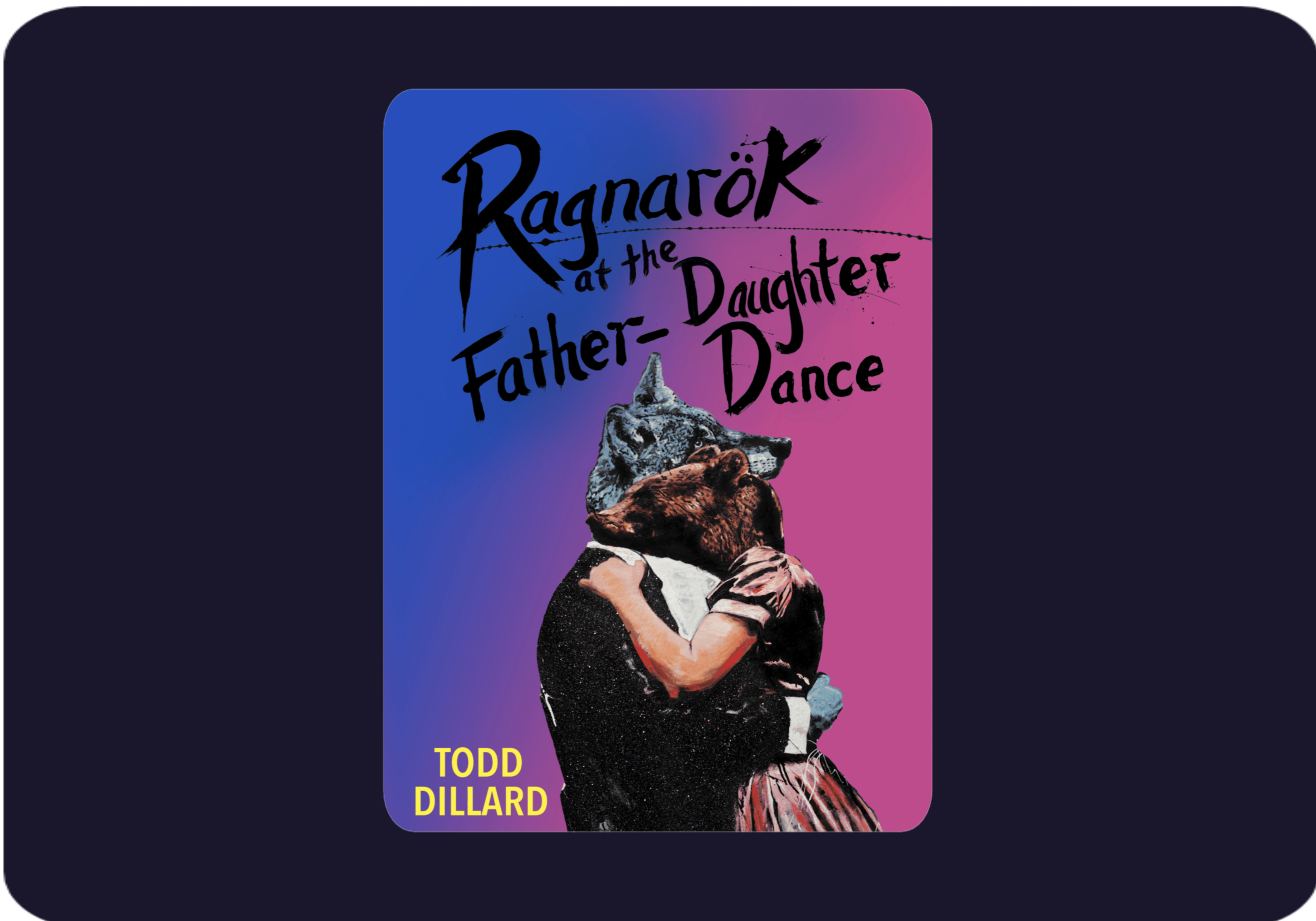
Ragnarök at the Father-Daughter Dance
by Todd Dillard
Variant Literature 2024, 42 pp., $7.00
Todd Dillard successfully transgresses the unspoken cultural embargo on creative work willing to grapple with the realities of the COVID-19 pandemic in his new chapbook, employing lithe and resonant language and carefully illustrated connections between lived experience and universal themes. Not playing coy, seven of the twenty-three poems have “pandemic” in the title, including “Ars Pandemic,” “Pandemic Dream: The Book of Gone,” and “Pandemic Menagerie.” The rest form a complementary suite, foregrounding parenting and relationship themes against a backdrop of uncertainty and grief. Many of the poems in Ragnarök at the Father-Daughter Dance (Variant Lit, 2024) also contain references to the specific time of their composition. “Tiny houses corona the air,” Dillard writes in “I Let the Foxes Live.” The virus’s presence strengthens the title and premise of “Nostalgia for the Ways I Used to Fear Death,” calling vivid pictures to mind with the simple words, “covid tests—positive—.”
Dillard adroitly straddles the line between documentary and intimacy to render not only the material upheaval of 2020, but also the acute impacts of that era on the inner lives of people. In “Pandemic Fairy Tale,” carefully selected details invite readers to inhabit both an external world, in which “the news announces flour shortages,” and a perceptive one, in which flowers, “breath-touched, bloom / into blue-pinched faces.” The verb “breadcrumb” is used in the poem to describe acts of persistence and invention,
in spite of there not being a path,
just a time that, once upon us,
is always upon us.
This poem’s speaker, like many in the book, operates at an uncertain temporal distance. Dillard exploits this perspective by seamlessly weaving immediate detail with more measured reflection. “My misunderstanding has turned / into my only way of understanding,” he asserts, offering readers analytical framing that mirrors one of the defining features of the COVID-19 Pandemic: its power to defamiliarize and interrogate previously submerged social norms.
Dillard’s style is often direct and vivid, but does not shy away from the abstract and surreal; he uses several techniques to defamiliarize quotidian detail—reminiscent of Charles Simic—that are well-matched to content. Perhaps the most striking example of this is a poem titled after an abstraction, “The Newness,” that is tightly composed around imagery of toilets. Dillard opens with a realist declarative sentence: “Sometimes you have to get rid of a toilet.” From there, he guides readers using a mixture of imaginative detail (“Do you know how easy a toilet shatters / under one sledgehammer swing?”) and carefully-enjambed revelation (“it’s like / when you died and, after, I broke / your life apart”), all of which culminate in a changed way of seeing:
Now when I go for walks I wonder
where a toilet would fit in. I wonder,
if you were here, what new place
you would pick to abandon.
Any future readers who did not live through the uncharted waters of 2020 will be able to approximate, through Dillard’s poetics, a sense of how disorienting it truly was to experience contagious waves of grief and uncertainty. All readers will encounter valuable reminders that the process of re-orienting opens a site of possibility, of invention—or, to borrow Dillard’s term, of Newness.
Among the most vivid analogies in the book are a pair of statements that orient readers in relation to grief, a shared emotional terrain for much of the pandemic experience. Dillard observes in “The Sadness of Horses” that,
horses have a blind spot extending
about six feet in front of them,
the depth we bury our dead
is the length of what they cannot see—
One of the book’s central projects is finding ways to conceive of the blind spot. In “No Rush,” he uses the language of dreams to render grief as domestic space:
Last night I dreamed
grief was an unlit room I had to clean.
Just as I figured out how to navigate its darkness
I put something away and had to learn all over.
Vision characterizes both of these skillful renditions of inner life marked by tragedy: seeing the blind spot; navigating the darkness. Just as grief helped push the world forward with fresh eyes in 2020, so does it propel Dillard’s speakers forward with changed perspectives.
Sadness and darkness are intensified by their contrast with children’s voices, often paraphrased, as an alternate route to fresh ways of seeing. “One Hundred Thousand Bells” uses the child’s persona to interrogate received frameworks, contrasting “the cartoon girl that’s meant to represent her” with real questions: “Where did my daughter learn what she buries / will always belong to her?” Similarly, “Edna,” a vivid scene of the father-daughter relationship, offers glimmers of childlike perception. When “The TV says a crane collapsed off 34th and / she wants to know if it’s because the crane was thirsty,” assumed categories—animal and machine—are briefly scrambled. Later, the speaker observes that “she loves it most when I swim away as fast as I can, / when my back becomes a shore that she’s trying to reach.” This joyful innocence contrasts poignantly with Dillard’s own experience of a receding horizon, in the deeply personal “Lighthouse,” when he writes, “some nights / this feeling—-everything is rushing away. I’m going to die.” The book contains many such resonances, adding depth and weight to what might, in other hands, have become merely a stylized collection of period-specific journal entries.
On the contrary, Dillard’s poems are careful and precise, seemingly aware of their challenge: to represent our collective experience with uncertainty in language. In “Pandemic (Good Advice),” the speaker—a father—says of his daughter, learning to swim,
I keep thinking I misunderstood, my daughter
didn’t mean perfect is what practice makes,
but that terror—it’s all around us, you can get used to it,
you just keep wading in.
The language is richly layered: literal description that becomes metaphor; specific experience that arcs towards the universal. Dillard also excels as a technician of the line, as in “How to Live,” when he writes,
Depravity begins with thinking of love
as a radical act. I quit loving
with difficulty. I love
easy now. Two parakeets on my shoulders.
The carefully broken lines probe and don’t fear to name. Perhaps this is because “silence is a type of touch, / which means a type of burial,” as the speaker asserts in “View from Euridice’s Shoulder.” Dillard’s commitment to speaking, to writing, to attempting to name an uncertain world even as it crumbles, is the engine within the book.
This chapbook does what I think any good group of poems ought to do, and that is to orbit a powerful central gravity. By tracing the surfaces presented to us by the poet, readers can approximate the mass and location of the dark matter underneath. Dillard’s insightful work guides us toward greater awareness of that dark matter, leaving readers a breadcrumb trail they might follow as they, too, attempt to dance with the dead in their own lives.