Collapsing Distance and Time
In conversation with
Anya Johnson on Desire, Voice, and Narrative Poems
.png)
KARAN
Anya, thank you for these poems, and many congratulations again for being the inaugural Bob Hicok fellow! Your poems seem different from what we usually encounter in poetry today – you have an outsider’s perspective. I don’t know if I’m making sense to you, but I am to myself. There’s something tonally alien about these poems that really appeals to me. Does that resonate with you on some level? How did you come to poetry?
ANYA
Thank you, it’s been a delight working with you and Bob! And you’re absolutely making sense. In my first thesis meeting, my advisor (Paige Ackerson-Kiely, who’s amazing) made notes on the pages where windows, doors, screens, and gates showed up. It was a significant stack. The recurring image was someone on the outside looking in, so the idea of outsider poetry clearly resonates with me. A couple of years ago, I would have said my work explores loneliness, intimacy, and distance. That still holds true. But now, I like to think the speaker of my poems approaches those subjects with more curiosity and playfulness. I love that you think there’s an alienness about them, that’s really exciting to hear!
Poetry came very naturally. My sister and I grew up on a largely uncultivated farm on the outskirts of Olympia, WA. It was pretty isolated and otherworldly: my mom homeschooled us and our house was over a century old and full of leaks, wasps nests, and wildness. Coyotes came up to the house at night and killed our chickens; a frog lived in our spice cabinet; there were definitely rodents in the walls. I also started acting in Shakespeare plays when I was five, so I was consuming elevated verse basically as soon as I learned to read.
KARAN
As an extension of the first question, where do your poems come from? How do you begin, write, and finish a poem? Are you a slow writer, an obsessive reviser, or…?
ANYA
This goes back to the outsider concept. For me to write poetry, I have to place myself at a bit of a remove from the world while absorbing as much as possible. It’s kind of a schizophrenic process: being an alert observer, alive to minutiae, and panning out to feel for connections between what I’m currently seeing/experiencing and the themes that are really loud in my life. I’m always trying to distill a specific mood rather than a specific idea. Then I revise towards clarity and try not to disrupt the atmosphere. I’m definitely better at endings than beginnings, probably because I don’t start a poem knowing where it’s going to land.
KARAN
In “Moon River,” you’re alone on a bus, hearing jazz, and you write: “Again, I am naming what I see / to no purpose. Tears stand milita / on my cheek, my hands make an empty / noise.” Then you’re crying at a café near your lover’s house, full of regret. What captures me here is the collapsing of distance between the speaker as witness and participant. Can you speak about that kind of awareness of self-consciousness?
ANYA
“Moon River” is a good example of the panning out idea. I was missing someone and kept making detours in hopes of running into them. I was also watching a lot of film noir. A jazz trio happened to be playing at the cafe where I was trying to write and they played “Moon River,” a song that always provokes a delicious melancholy in me (as well as the image of Audrey Hepburn on her fire escape in Breakfast at Tiffanny’s). That song acted as a trigger and I was able to zoom out and look at all the ways I’ve been frustrated in love with compassion and some levity at the drama and transience of strong emotion.
Collapsing distance and time is essential to writing—how else can world-building happen? I’ve definitely been cross-examined in workshops for shifting tense or POV mid-poem or story, but if it’s done with intention and confidence, it can be marvelous.
KARAN
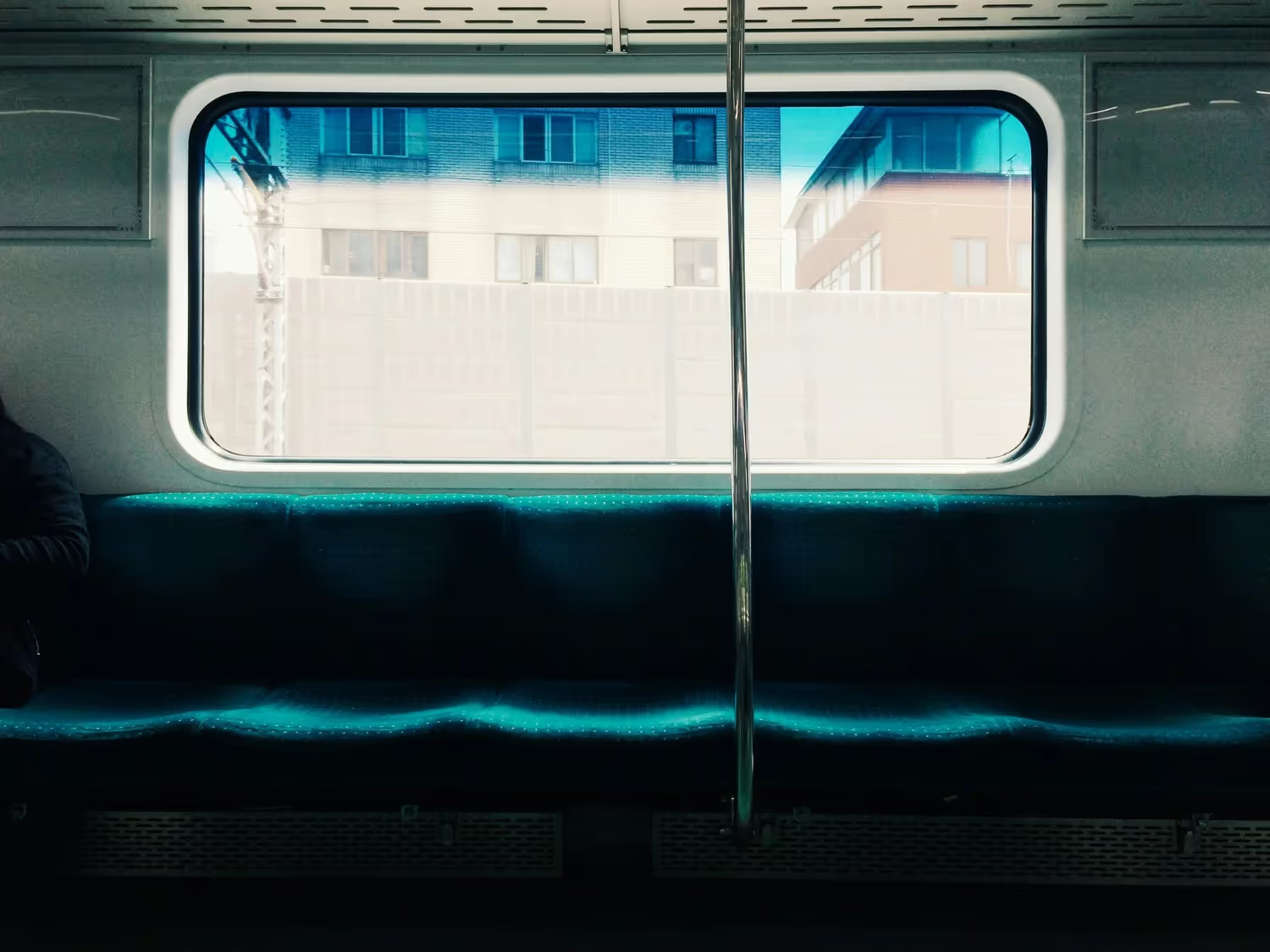
“Girl Like Me” is extraordinary. A woman on the subway says, “I’m really horny.” The man doesn't understand. She says, “This is a good stop to get off on.” The men laugh, clap him on the back. You write, “I wanted to be in the on the joke, / the back-slapping, to be immune. / Then I remembered / my life.” Oooof, that last line! What is it about female desire—its ambiguity, its misreading—that draws you as a subject?
ANYA
Everything! Desire is so full of contradictions! But specifically, growing up in a female body, in America, sex was more commodity than pleasure, and female desire rarely entered the equation. When it did, it was filtered through a masculine, capitalist lens and was something to be mapped out or repaired. This poem specifically is about sex work, in this very public container of a train car, and how my mind can bifurcate between judgement and identification to the point where I forget my own lived experience. It’s a subject I’ve been trying to explore in an experimental novel which I’ve been plodding along with for the last couple years.
KARAN
“Parable” is a prose poem about a porcelain nun you bought at an antique mall to hide condoms in. “I felt I had disappointed the shop ladies. I had nothing to confess.” There’s so much shame and emptiness in that poem. How do you approach writing about shame without apologizing for it, or feeling embarrassed?
ANYA
It’s really hard to embarrass me. I’m honest to a fault and have a pretty checkered past so shame is usually only attached to instances in which I’ve lied or hurt another person. There’s emptiness in this poem but not shame. With certain traumas though—abuse, rape, abortion, etc.—I’ve needed a slant to write about in a way that felt true. The figurine became a vehicle for that.
KARAN
“Hey, Shannon” references foil, a lighter, a fire – there’s an implicit danger of self-harm. You’re waiting for news that one of you is dead. Then: “Yeah, I’m still here.” Walk us through how you write about precarity like this. How do you balance specificity with the reader’s need to understand?
ANYA
This was a pretty straightforward recounting of a FaceTime call with a friend when we were both in the middle of a relapse. I didn’t know how to process seeing someone I loved, and had met in recovery, smoking heroin in front of me, or how completely addiction had stolen my life again after years of my own sobriety. I ended up tweaking some images that were clearer in my head than on the page but ultimately, this being a legible encounter wasn’t so important to me.
KARAN
“To the Teeth” is a long prose poem that catalogs your fears, anxieties, and anger—at people who chew audibly, who clip coupons. Then you mention your sister in Morocco, called “a real Berber woman,” riding a camel. The poem doesn’t resolve any of this. It just accumulates. What draws you to the catalog form? What does accumulation do that argument can’t?
ANYA
The unrelentingness of prose poetry is a good match for fear and anger. A text block doesn’t have negative space and doesn’t invite slowness. My impulse is to revise by accretion and contradiction rather than cutting. Ultimately, I don’t think poetry is about resolution, or argument. At least not mine. Luckily, art doesn’t need to be utile.
KARAN
Your poems move between lyric and narrative, between song and confession. How do you choose your register poem to poem? What makes you reach for lyricism versus straightforwardness? And what are your thoughts on voice? Do you think you’ve found your capital-V voice?
ANYA
My trusted readers would say I have a voice, but I feel like it’s always changing. I wrote mostly narrative poems for a couple of years and then that started to feel stale, but people seem to respond to narrative better in general. I admire lyric and narrative poets equally.
I’m laughing at the idea of choosing a register because I don’t think I have any control over that. I wish I did! Maybe the mood that creates the environment for a poem dictates the register and the register dictates the form and the level of directness.
KARAN
This is a question we ask all our poets, though the answers are always so wildly different: there’s a theory that a poet’s work tends toward one of four major axes—poetry of the body, poetry of the mind, poetry of the heart, or poetry of the soul. Where would you place your work, if at all?
ANYA
Where do you think it lives? I’m not sure I can make a division between the axes. My instinct is to say mind and soul but that feels self-aggrandizing. I’m also not particularly academic in the classical sense. If we’re looking at the poems in this portfolio, I read body and heart. So maybe my aspirations don't match my actual output.
KARAN
What’s the best piece of writing advice you’ve ever received? Additionally: what would you tell other poets about writing desire—female desire especially—without hedging?
ANYA
Read your drafts aloud. It becomes much easier to hear where the lines want to break. And if you’re like me, you’ll stumble on words or lines that are trying to work their way out of the poem. As to writing desire, I think it’s helpful to practice naming exactly what you want without figurative language. It becomes easier to avoid cliche on the page and (hopefully) transfers into more directness off the page.
KARAN
Would you offer our readers a poetry prompt—something simple, strange, or rigorous—to help them begin a new poem?
ANYA
- Make a list of images, comments, and moments that have stuck with you indelibly, whether or not they are welcome or seem significant (mine might include the texture of the closet door in my childhood bedroom or an ex-boyfriend advising me to travel light so I could look sexy walking through the airport).
- Write down any connections.
- Describe a thought or behavior that you believed was entirely unique to you and later discovered was commonplace.
- Write a prose poem with this material and don’t edit or erase anything.
- Put it away.
- In a day or a week, rewrite the poem from memory to the best of your ability, adding anything that has since occurred to you.
- Repeat the process until you're not discovering anything new.
- Compare the drafts and see what’s there.
KARAN
Please recommend a piece of art (a film, a song, a painting, anything other than a poem) that's sustained you lately or that you wish everyone could experience.
ANYA
Compagnia de' Colombari's bare-bones production of King Lear was shockingly beautiful. This winter, I saw it with three friends that had varying levels of interest in Shakespeare, and all four of us were knocked out. In the final scene, Cordelia and Lear emerge from a dressing room at the back of the space and do this slow, backlit procession downstage before Lear dies in her arms. It was like being inside scripture. Thank God AI can’t make theater.
KARAN
And finally, Anya, who are the poets or writers who’ve most shaped your sense of what’s possible in language?
ANYA
Anne Carson lit it all up for me when I started reading contemporary poetry. Then my dad gave me Marie Howe’s What the Living Do in college and that gave me a template for perfect narrative poems—that and Raymond Carver’s All of Us. Shane McCrae, Kaveh Akbar, Linda Gregg, Sharon Olds, and Jorie Graham all expanded my field of vision. Chessy Normile taught me that humor and absurdity can coexist with deep feelings. Richie Hoffman is oracular on sensuality and beauty. Mary Ruefle though, she’s my ideal.
RECOMMENDATIONS
Compagnia de' Colombari's production of King Lear
POETRY PROMPT
- Make a list of images, comments, and moments that have stuck with you indelibly, whether or not they are welcome or seem significant (mine might include the texture of the closet door in my childhood bedroom or an ex-boyfriend advising me to travel light so I could look sexy walking through the airport).
- Write down any connections.
- Describe a thought or behavior that you believed was entirely unique to you and later discovered was commonplace.
- Write a prose poem with this material and don’t edit or erase anything.
- Put it away.
- In a day or a week, rewrite the poem from memory to the best of your ability, adding anything that has since occurred to you.
- Repeat the process until you're not discovering anything new.
- Compare the drafts and see what’s there.
MOST INFLUENTIAL POETS
Anne Carson
Marie Howe
Raymond Carver
Shane McCrae
Kaveh Akbar
Linda Gregg
Sharon Olds
Jorie Graham
Chessy Normile
Richie Hoffman
Mary Ruefle

MOST INFLUENTIAL POETS
Anne Carson
Marie Howe
Raymond Carver
Shane McCrae
Kaveh Akbar
Linda Gregg
Sharon Olds
Jorie Graham
Chessy Normile
Richie Hoffman
Mary Ruefle



.avif)