Everything is unbearably ornamental
In conversation with
On religion, shame, and the prose poem as pilgrimage
KARAN
Religion saturates these poems. Catholic conversion, sainthood, your grandfather rhyming your name “with Gethsemani.” You write, “It’s all so religious, the way I was born, the way I will leave.” What role does religion play in your work? Is it inheritance, violence, metaphor, or something else?
STEPHANIE
I attended a really small private Christian school on financial aid from second grade up until I graduated high school, and my memories consist mainly of singing Hillsong and Imagine Dragons songs in the same breath on Fridays, mandatory wilderness retreat camps in which One Found God, mega-church cliques, rampant homophobia, and being forced to watch YouTube documentaries that spouted anti-climate change propaganda in order to pass a class. It was a strange place: co-ed, no uniforms, no sex ed. My mother converted to Christianity as part of the admissions process on the parent’s part and spent years trying to get my father to go to church with her until they separated in my early teens. That aside, my grandfather was a devout Catholic, and his was the first funeral I ever attended. We were never close and I always saw him somewhat in grayscale. He played solitaire on the computer all day but my grandmother loved him very much, so much so she converted from Buddhism to Catholicism for him, after my aunt and cousins. He died the same day I had a shift scheduled at Starbucks, and I got to witness him one last time, in color, before the funeral. It was held at a Catholic church I drove by countless times before, thought nothing of. All I could think then, slumped in the pew, eyeing the priest: everything is unbearably ornamental.
The answer is all of the above. I like to think that religion has exhausted itself in my poems at last, that I’ve outwitted it. If it’s an inheritance, I’d like to think it spent. Religion was exhausting, the show and dance, there’s always an outpouring, an excess of sin now transmutated into salvation, enough to induce awe. Yes, I do feel born into it. I’m not a religious person today, but it’s a sticky thing, freshly cauterized. Although there were certainly moments of violence and growing up, violation, I don’t see it playing a violent role now so much as a stubborn one. Like a spam caller. It’s interesting, too, because the Sainthoods are older poems that served a kind of self-soothing, self-actualizing function. I started writing them in fragments during my gap year before college, feverish and mythical in their infancy. In my poems, family and religion are inseparable entities stitched together. Christian religion specifically bears the reason for a lot of the shame and guilt my mother, sister, and I felt at different stages in our lives. Poetry is a means of working through that for me. We would be happier had it not happened to us!
KARAN
“Moonflower” breaks my heart. “This is the closest thing to a promise: your palms. Still and still not swallowed by nightfall.” Then: “It is only summer, and possible that I am no longer promised to you.” You seem fascinated by the form of the prose poem. Will you tell us what appeals to you about it?
STEPHANIE
I’m intrigued by what remains—what qualities are left of a poem that still make it a poem— when you lose the possibility of line breaks and enjambment. For a while I wasn’t sure what distinguished a prose poem from a paragraph. And for Moonflower, it was always a block of text in each iteration; it entered my mind that way, whole and intact. I wanted each scene to flow soundlessly into the next. No distractions or embellishments. Is it alright to say that I feel deeply honored by your first sentence? If a lineated poem can break a reader’s heart by dropping it suddenly, shattering it… maybe a prose poem breaks it in a refusal to look away? By coaxing the reader into the water, before they realize it’s rising too quickly? There’s a sense of linear time I can hold onto with greater certainty in a prose poem, I think.
These days, I’m partial to what Matthew Zapruder has to say, such as that “poems allow language its inherent provisionality, uncertainty, and slippages.” Without the stanza to drive this tumbling forward, we rely on the grounding effect of punctuation; no matter the direction a prose poem wanders, it’s tethered to a shape that’s meant to stretch across the page. In a prose poem, there’s no distance between sentences, nowhere to hide. Meaning-making is elongated. Less to do with a cornfield maze and more a pilgrimage, perhaps. I resonate deeply with Ethel Rackin’s take on prose poetry in her ONLY POEMS interview: “the form suggests a narrative without necessitating the development of a traditional story.”
KARAN
What’s the best piece of writing advice you’ve ever received? Alternatively: what would you tell other young writers about finding their voice or staying committed to the work?
STEPHANIE
To consider place in my poems! Where, literally or figuratively, are the events of a poem taking place? Where is it located or situated, in space and time? The physical, emotional, mental landscape? It sounds really obvious, but having mentored young writers in the past, it’s a question that not everyone can answer in the first draft.
KARAN
Would you offer our readers a poetry prompt—something simple, strange, or rigorous—to help them begin a new poem?
STEPHANIE
I love to wear different voices in my poems, especially when they can reach across registers and emotional landscapes. A persona poem embodies as much as it interrogates, be it from the perspective of a fictional, historical, or impossible self, it takes inventory of one such point of view. In this way, you can shine a kaleidoscope over the ordinary. I find it most helpful in inventing the mythology that surrounds a particular interest or concept I have yet to fully flesh out. So I offer you this: Write a persona poem in which the speaker is the god of something.
KARAN
Please recommend a piece of art (a film, a song, a video game, anything other than a poem) that's sustained you lately or that you wish everyone could experience.
STEPHANIE
I picked up Susie Boyt’s novel Loved and Missed at a bookstore in Long Island City about a month ago in preparation for spending the holidays alone. Around the same time I had started a journaling practice, morning pages and the sort, and copied down passages, quips, and tensions in the story that touched me. It’s the kind of book that obliterates you with the melancholy of the mundane and the extraordinary absurdism of having a second chance at something. I’m afraid that’s a recurring effort of my poems, for better or for worse: everyday heartbreak dressed up in momentary decadence and “oh.” moments.
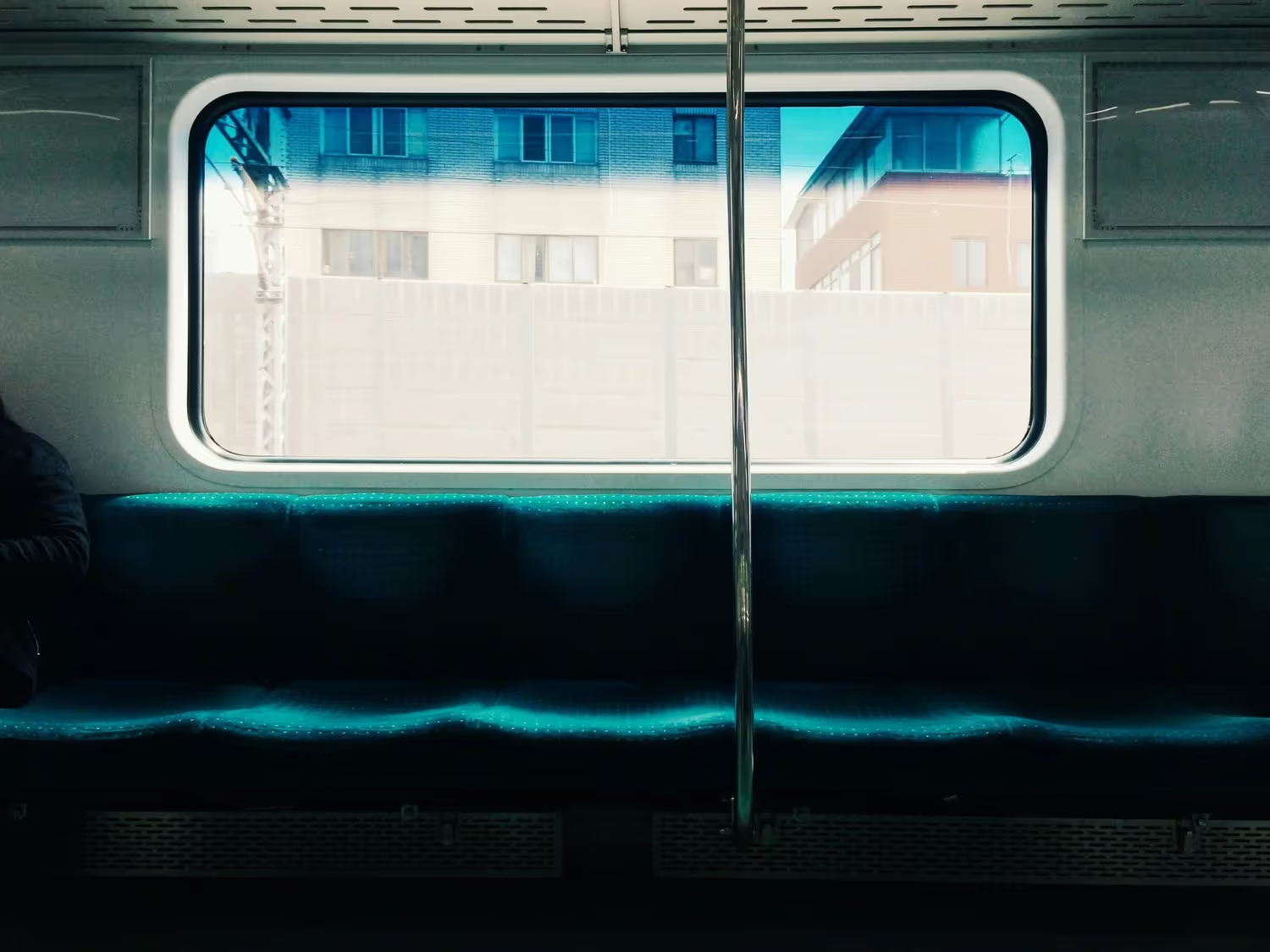
Left alone in my apartment, I read it over the course of Christmas Eve and Christmas Day, on my bed and then at a café, before eventually finishing it on the subway on the way to work. I dog-eared endless pages but everything Boyt said made all the sense in the world to me, it would’ve driven me mad not to. I’d probably credit Loved and Missed for getting me back into the ritual of reading novels, as opposed to essays and articles and of course, poems. It was grim and luminous if you squinted and perfect. The word “bright” gets repeated a lot. This an intergenerational meditation on grief without unnecessary flourish, occupied with the intricacies of people living their lives, what we inadvertently inherit. I have such a fondness for this book. Characters with idiosyncrasies I associate with my mother blossomed into my own likeness in no time at all, and by the end I was tearing up on the train.
KARAN
And finally, Stephanie, who are the poets or artists who've most shaped your sense of what's possible in language?
STEPHANIE
So much of my poetry is born from ekphrasis that I feel inclined to talk about both the writers and visual artists alike, whose work I return to time and time again.
Among poets, there’s Talin Tahajian, Sally Wen Mao, Richie Hofmann, K-Ming Chang, Hanif Abqurraqib, Paige Lewis, and Kaveh Akbar. It’s funny because I’ve been reading these poets—many of whom now write in other modes, too—since high school. Now, as a young adult working a 9-6 and living in Bushwick with two roommates and a cat I adopted off the street, I have yet to outgrow their words, which seem to only envelope themselves brighter around my world. I often blink and see Tahajian’s “grey borzoi / [flickering] against the shoreline” whenever somebody mentions the ocean. A few weeks ago, I asked my partner to read Akbar’s poem The Miracle out loud to me, and remember shuddering as if I myself were to be summoned that instant by some divine, familiar force. All these poets remind me of the ways language can be wielded toward catharsis, empathy, beauty, destruction, and so on. (Can I also mention poets who I would consider my peers, too? My dear friend Grace Song, to be sure. Joseph Lee, Cynthia Gan, Leo Dong, Niamh Cahill, Alex Aureden, Mercuri Lam, Matthew Toth—I’m always learning from how they understand and maneuver language in such masterful ways.)
I studied art history and moved to New York to work in the art world, so I would be remiss not to mention Ren Hang, Miya Ando, Patty Chang, Cindy Sherman, Edward Hopper, Catherine Murphy, and Émilie Charmy as influences. Photographs of queer ecological landscapes, lonely people in busy cities, and picnic blankets on pillowy grass bubble beneath the surface of my writing, whether or not those images persist in the final draft. At the end of the day, my poetry is animated and organized by visual experience, and my favorite frustration is sitting in a museum, staring up at a work of art when it’s stricken me to my bones, thrust in a fit of wonder, and I cannot put into words why I feel the way I do.




.avif)
.avif)
.avif)
.png)