Whittling Away at Dream Logic
In conversation with
Surrealist narratives and editing for the short poem
%20by%20Maruja%20Mallo%20(1926).png)
KARAN
Laura, thank you for your poems. “The Public Domain” opens with a tiny dead man in a peanut shell who you’ve been “looking for / your whole / life.” Death becomes the moment when “they can look / you up, and you can’t look back. All / our secrets gushed / up all over the internet.” That idea of the public domain as death is brilliant. Let’s begin with the famous process question. How do you begin, write, and finish a poem? Do you have a writing routine? And most importantly, why poetry?
LAURA
I've had just about every writing routine imaginable, I think. And I always move on to another writing routine. But it always starts as a journal, regardless of the time of day or place I'm writing, with a just a drugstore notebook and a ballpoint pen. Sometimes all I write are journal entries, but if anything is going to turn into a poem, it starts as a journal entry.
KARAN
“I Was Bonnie & Clyde” is wild. The catalog of impossible identities: “I was Jekel & Hyde,” “I was His Cigarette Stub,” “I was Ham (the astrochimp) & I / was launched / into space.” You’re splitting the self into mythological, biblical, pop culture, and personal fragments. Where did this poem come from? Why did you choose to title the book after this poem?
LAURA
That poem has been stalking me for years. It has, at times, been 30+ pages long. There's something about all the poems that was inspired by the tedious writing and revising of that poem. I very much appreciate your description of it as splitting the self into personal fragments!
KARAN
“Physical Education” chronicles all those hours spent “braiding / my braids & painting my nails & glossing / my lips & scorching my wings.” Then you end with these paradoxes: “The confusion of the past / as fireproof as ash. / The follies of the future / as bulletproof as water.” I love the logic of those similes. Is “craft” a concern for you? Do you think about the poem-ness of a poem as you write it?
LAURA
I like to think that I've thought about craft so much that it just miraculously thinks of itself while I'm writing. But, in truth, I do think a lot about it when I revise, and much more so when I write short poems. For a long time I just avoided short poems because I was too self-conscious about craft to dare go out in public wearing so few words. Now I'm finding the challenge and art in poetry to be in whittling. This was another poem that was very, very long at one time.
KARAN
War appears throughout these poems: “The rats of war / get fat before / they starve / to death.” In “Torture,” you connect Latin etymology to bombs, to “a child’s / terrible / performance.” In “Gift Shop,” souvenirs trigger apocalypse. Bob (Hicok) has this opening somewhere: “There is a war. // No matter when you’re reading this, this is true.” And it is true and encapsulates the eternal nature of violence in human history. Is war & violence a preoccupation for you?
LAURA
I guess I find out what I'm preoccupied by from what I write about. There is, come to think of it, a lot of war in my poetry, and violence. And ever more war and violence in the world!
KARAN
I also noticed that throughout the book, your poems are so compressed, even ones that are longer in length (I don’t know how to explain that). But more overtly, “Similes” and “Always” are just a few lines. You also work with the short line. What draws you to brevity? How do you know when a poem is finished versus when it needs more?
LAURA
Well, this interest in brevity has always been with me, and the poems I've loved the most are short, mysterious, image-centered. But my own poems have rarely been those things! However, I've always felt like my best poems were my shorter ones. They're just a lot harder to write, for me, than long poems. I know when a long poem must end but I'm very much still trying to figure that out about short poems.
KARAN
“Gift Shop” imagines souvenirs causing catastrophe: shake a snow globe and an A-bomb drops, strike a match and California catches fire. You end with “even though these knick- / nack spoons are too / small to eat with and too / shiny to be gold, we / buy them anyway / to throw away at home.” That encapsulates a certain kind of truth that seems almost universal. What does kitsch have to do with the apocalypse?
LAURA
I think that poem is a criticism of my own consumer tendencies. I admit I'm the kind of person who visits the gift shop at the art museum before I look at the art. I want to know what I can take home. This is the kind of attitude that landfills overflow with and that leads straight to apocalypse!
KARAN
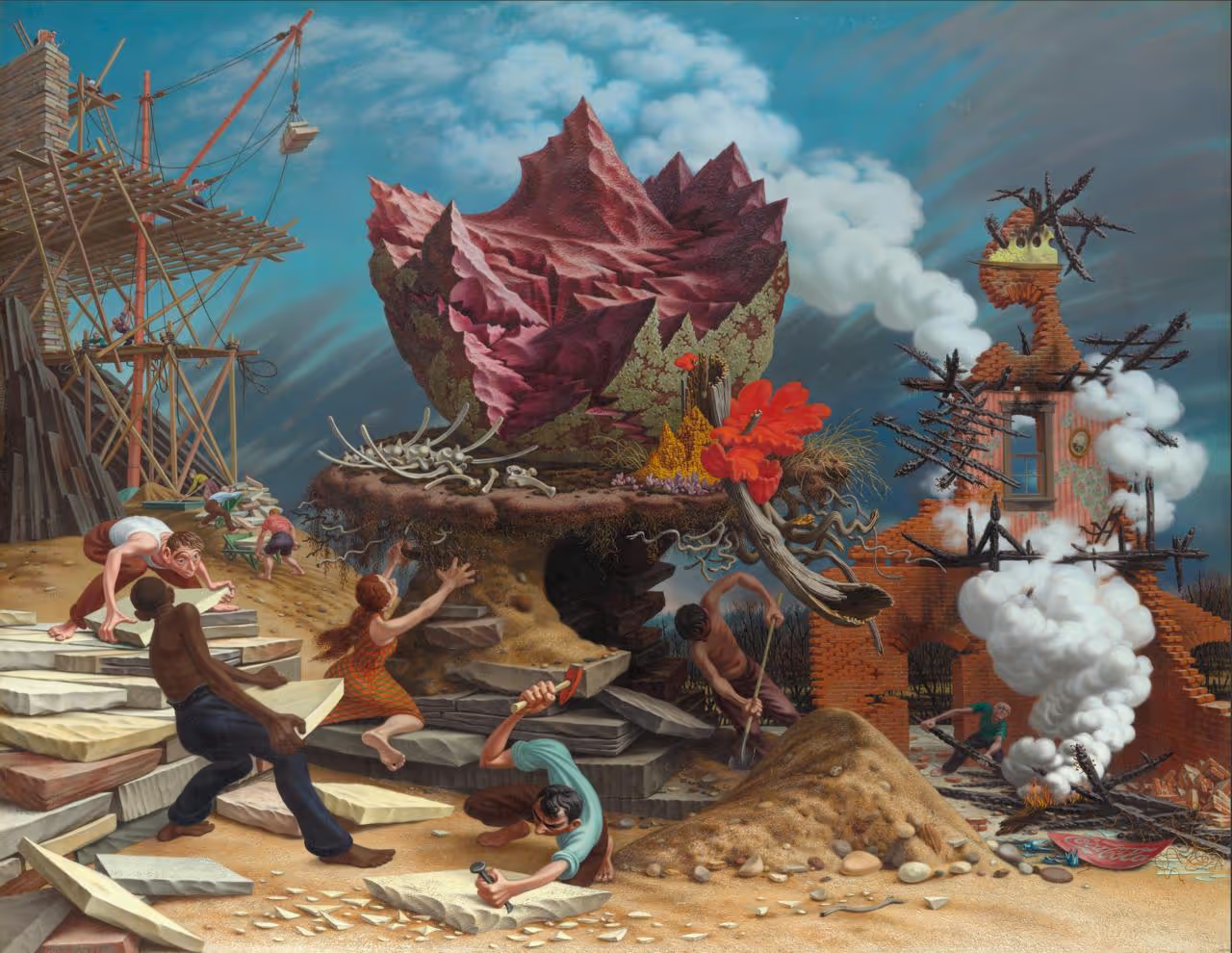
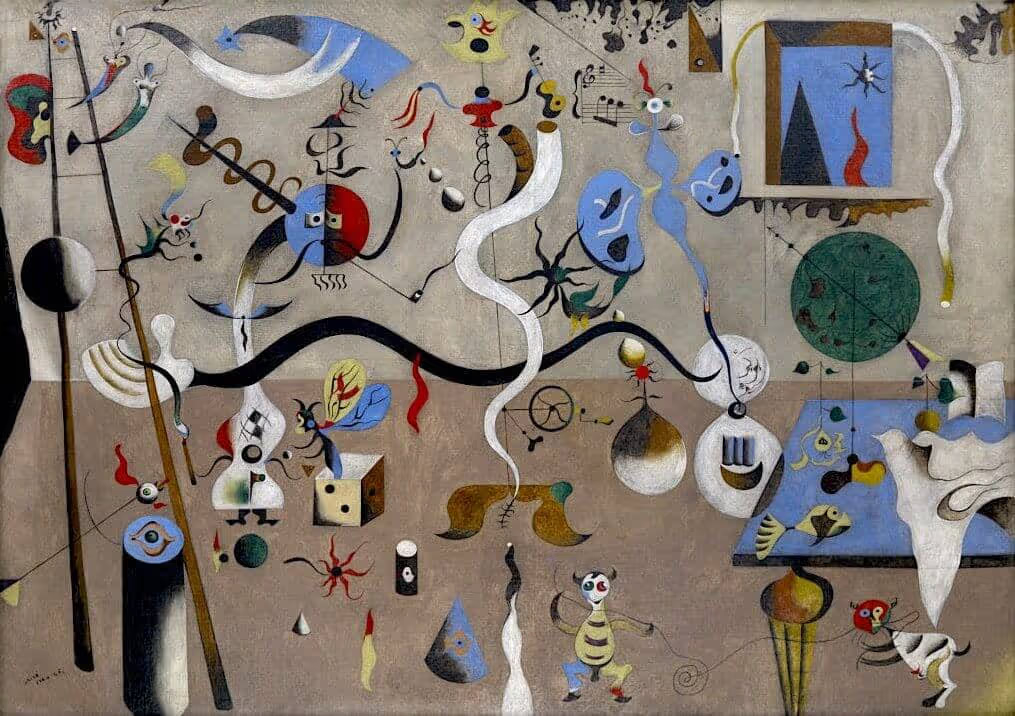
The logic in these poems is dream logic, surreal logic. A dead man in a peanut shell, a nanny walking into traffic, Ham the astrochimp speaking to God. How did you cultivate this surreal sensibility?
LAURA
I can honestly remember the day I bought Michael Benedikt's anthology of surrealist poetry from a used bookstore, taking it back to the dorm, and I've never wandered very far from that anthology since. My interest as a writer has always associative since I first learned about automatic writing. If most of a poem isn't being written by my subconscious, I'm not writing poetry.
KARAN
How does your experience with fiction shape your poems, Laura? Does narrative thinking seep in, or do you keep them separate?
LAURA
I think I started writing fiction because narrative was my impulse in poetry, so I thought maybe fiction would be similar. It's not! There's just nothing about novel-writing that is similar to writing poetry for me, and I don't really write short fiction (on purpose anyway). Novel-writing feels so low-stakes because, for me, it is a totally an optional genre! I do think sometimes that I'd be a better poet if I didn't write novels, but I know for sure that I can't be a better novelist because I really have no idea what I'm doing and, unlike with poetry, I've never felt passionate enough to learn everything I could. (Not that I could learn everything there is to know about poetry writing, but I'm always trying to learn, at least!)
KARAN
This is a question we ask all our poets, because the answers are always so wildly different: there’s a theory that a poet’s work tends toward one of four major axes—poetry of the body, poetry of the mind, poetry of the heart, or poetry of the soul. Where would you place your work, if at all?
LAURA
I'd like to think I'm a poet of the body; I really do believe 'there's no ideas but in things.' What I remember from poetry is always sensory, and what inspires me to write poetry is as well.
KARAN
You teach at the University of Michigan, you’ve published widely acclaimed novels alongside poetry and have won multiple prestigious awards. What is something you’d like to say to emerging writers, by way of advice or caveats?
LAURA
Writing is its own reward. I'm very happy I've been able to publish my writing, but I would never have bothered to write anything to publish if I hadn't learned what I want to write about and found some processes over the years that made that fun. Writer's block happens when you've stopped having fun, are worried about publishing, being a perfectionist, or trying to censor yourself and write at the same time. My career has had some lovely "ups" and some astonishing "downs"—just like the rest of my life—but so far the constant has been that I keep feeling the urge to write, and then I keep emerging from the writing feeling better than I did before I wrote, even when the writing itself isn't anything you'd call successful.
KARAN
Would you offer our readers a poetry prompt—something simple, strange, or rigorous—to help them begin a new poem?
LAURA
What if you were given an apple by a stranger? What if you decided to eat it, despite the potentially poor decision that could be? What if that apple said your name when you bit into it?
What else might it say?
Begin writing this prompt by describing a stranger, approaching you with an apple. Describe the stranger. Then describe the apple. Describe the taste and smell and weight of it. Then let your freewrite lead you to the end of the prompt, and to what this stranger’s apple says to you while you’re eating it.
KARAN
Please recommend a piece of art (a film, a song, a painting, anything other than a poem) that’s sustained you lately or that you wish everyone could experience.
LAURA
I've been greatly enjoying the renewed attention being paid to and some new collections of the photography of Ralph Eugene Meatyard.
KARAN
And finally, Laura, since we believe in studying masters’ masters, who are the poets or artists who’ve most shaped your sense of what’s possible in language?
LAURA
My first loves were Yeats and Plath and Dylan Thomas. I moved from them straight into the surrealists, so a lot of the poetry that informed my own at the start wasn't work I could read in its original language. So, perhaps I've been influenced by translators, particularly of Transtromer and Reverdy and Apollinaire. But the first living poet whose work obsessed me was Laura Jensen, and I think I know more of her poetry by heart than anyone else's. And I find Alice Notley's book "Descent of Alette" so radioactively brilliant that I can only read it with my eyes closed.
RECOMMENDATIONS
The photography of Ralph Eugene Meatyard.
POETRY PROMPT
What if you were given an apple by a stranger? What if you decided to eat it, despite the potentially poor decision that could be? What if that apple said your name when you bit into it?
What else might it say?
Begin writing this prompt by describing a stranger, approaching you with an apple. Describe the stranger. Then describe the apple. Describe the taste and smell and weight of it. Then let your freewrite lead you to the end of the prompt, and to what this stranger’s apple says to you while you’re eating it.






.png)
.avif)

.avif)