The Mythologies of Life, Death, and Community
In conversation with
The universal as intimacy with family and community
.avif)
KARAN
Kazim, “Qasida” is extraordinary. The poem fractures as it goes—syntax breaking down, words bleeding into each other. “The falt is gathered is fluid flute in felt sound out flet’s fault.” I like the dismantling of language here. You write, “Who without the written can speak / Who with only vowels can love.” What happens when language fails? Is the breakdown formal experiment, or does it enact something about grief, about crossing borders, about being denied a life that is not fragmented?
KAZIM
The “qasida” was a traditional poem of desert peoples—it had multiple parts and was performed. In one part, the poet happens upon the remains of a campfire; the tribe has gone ahead without them. In another section, he mourns the lost love, in a final section he sings a song of praise in hopes of being restored. The “qasida” doesn’t truly translate into English, since it is embedded—at its core—in cultural values of community and care and the precarity of the geographical environment which meant that alienation from the community was literally perilous, even deathly. Formally, too, the qasida belongs to the languages of the region—in which the traditional monometer and monorhyme are easily achieved—far less so than in English.
Yet something about the spirit of the qasida—the deeply felt tension between an individual and his community, the ardor felt by one who alone—feels very intimate and personal and present to me. So my “qasida” is an attempt at adapting not the poetic form itself, but maybe the more ancient human urges that required its formation in the first place. For this reason, my language sank down beneath the surface of commonly intelligible English. I like the idea of the language itself breaking apart, becoming unknown, the way a language might be in a new community, how new groups of people left on their own begin to migrate their mother tongue into new words and expressions to define their new condition.
Vowels may—may—be universal. “Aaaaaah, ohhhhhh, and ooooooooooh, and eeeeeeee” may communicate pleasure/awe, inquisitiveness, interest, or discomfort in multiple languages. “Mmmmmm” likewise is an ancient sound for nourishment (probably, I imagine, from the sound of a mouth on a mother’s breast; and “yum” is the bhij mantra associated with the heart chakra). Now my friend Neil Theise has revealed the startling medical discovery that there are nadis of energy (fluid energy, hyaluronic acid to be specific) that flow through the human body in small tributaries and great large rivers. The ancient sages of Hindustan knew about it a very long time ago.
So in a poem, for me, there is the possibility for universal energy to coalesce. There is a possibility for us to see past our own limitations and experience and social constraints. Language has been a very useful tool for humans, and for humans in power to create hierarchies of desire and even ecstasy. When one breaks down language, one can do it at the sentence level, at the level of a line transitioning to another line or stanza, and in the architecture of the poem. When one turns one's back on the received and previously understood, one perhaps surrenders the ease of intelligibility and epiphany, but it is an invitation to the universal and unspeakable and unspoken to manifest.
KARAN
You coined the term “genre-queer” to describe literature that blurs poetry, fiction, nonfiction. These poems themselves blur registers—the lyric, the elegy, the philosophical meditation. “Qasida” includes a checkpoint where you “refused to provide evidence of our nationality.” How do you think about genre as a form of border? What does it mean to refuse categorization?
KAZIM
I coined the term in 2008 or 2009, although it is quite common now and used in many different contexts, including beyond the literary. When I first started using the term, I was trying to talk about my book Bright Felon, and for callow reasons: I was trying to make the context of the book legible for readers. Had I only trusted then my own feelings about intelligibility. I’d been reading a lot of gender theory, including Riki Wilchins’s book Genderqueer. It occurred to me then that genre, the way Wilchins and other genderqueer, trans, and intersex activists were writing about it, had a lot to do with the question of literary genre. Far from being harmless ways to categorize a text for ease in marketing or shelving in a library, the labels of genre were methods of controlling the energies of a text, harnessing its weirdness (feel free to read “queerness” for “weirdness”), and circumscribing alternate ways of approaching and interpreting the text. Texts that defied or denied traditional genre distinctions were often relegated as “poetry,” no matter their actual intentions or affinities.
It mattered to me because I had written Bright Felon as a memoir, an autobiography, and had some notions that I wanted it to be read as such. The first term I came up with was “transgenre” (and its this term that appears in the original jacket copy). But that term implied too much of a one-way movement. Even in transgender politics, the point is not to adopt India’s or Iran’s supposedly progressive policies on transness which further fix notions of gender performance (i.e. Iran’s government will subsidize gender reassignment surgery for male-bodied people wishing to transition to living as a woman but will not offer civil protection or rights to gay men or lesbians, nor provide transition support to female-bodied wishing to live as men; while India offered civil protection as a “third gender” to transgender people under a 2019 law, the 2026 amendments scale back these protections).
In the end, I realized that I too was enacting the same kind of anxiety—genre anxiety rather than gender anxiety—in trying to determine “what” Bright Felon was or “how” it ought to be read. The term “genrequeer” seemed more generous, more all-encompassing, it seemed to give the power of the encounter back to the reader.
KARAN
“Some Questions He Asked” is a devastating elegy for your mother. “It had been dusk, I held your hand, we knew some part of you was gone / and yet you lived and breathed.” You climb into the grave to turn her on her side, making a pillow so she could face the mosque she loved. You refuse myth: “But it is not a myth and we are not mythical.” How do you write about your mother’s death without reducing her to a symbol? What does myth do that reality can’t, and vice versa?
KAZIM
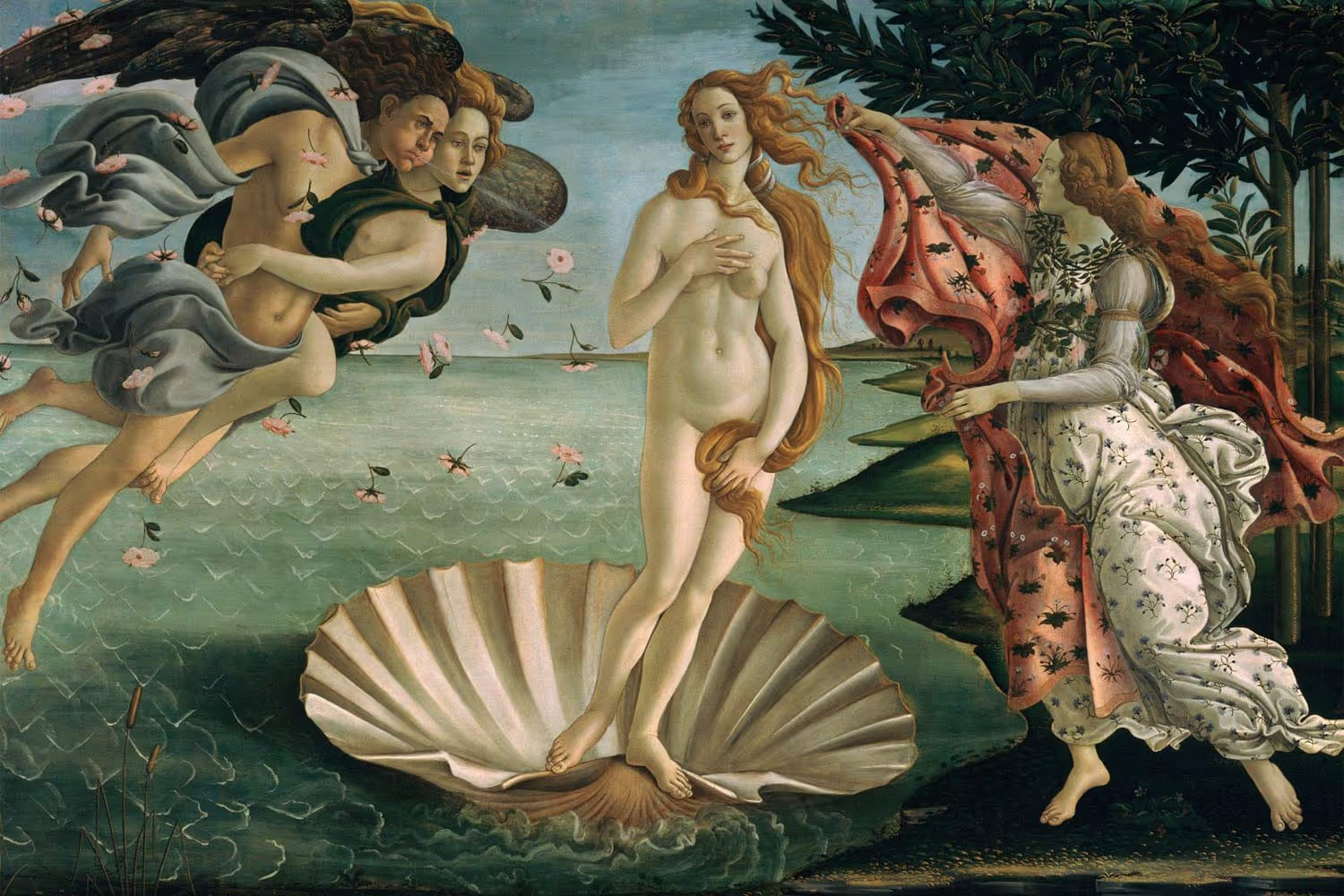
She could never be a symbol while alive because she was flesh and blood and breath and my mother. The danger was that after leaving her form, she could become a symbol if I was not careful. The easiest was to pretend she was, to put it all into myth. I think that’s why at the end I had to say, “it is not a myth.” The Islamic rituals of death are visceral. One does climb next to the body and turn it. I turned her. I shook her shoulders—I think it is to remind the person inside that it is time to fly forth. After burying a person, one is not supposed to remain at the graveside in vigil but leave and return home. The person must leave their shape. Only myth could help me live through those days. And all the days since. That she is still alive, in spirit and energy, that breath transcends, that we will see each other again some day. Myths perhaps, but vital.
KARAN
In “Some Questions He Asked,” you describe your mother as “a tomboy from Hyderabad who sang and climbed trees and stole her cousin’s / bike to ride around the neighborhood, laughing the whole way.” I love that detail. That specificity breaks through the philosophical questioning. How do you balance the particular and the universal in elegy? When does the specific become more powerful than abstraction?
KAZIM
Well, because the tension in that poem is between the mythical and the real, and I position myself as Orpheus and her as Clio (the Muse of History, Orpheus’s mother in the myths), I needed the local and ordinary to ground her. So she’s Clio, but she’s also a tomboy riding her cousin’s stolen bike through Hyderabad. Those specificities ground her in her human body despite her (and ours all) divine nature. After she died, there were a lot of elegies for her generous spirit (she was), her great cooking (it’s true), her sweet disposition (the sweetest, unless you were her kid and you hadn’t picked up your room or done your homework), I kind of felt like people were talking about a stranger. I needed to bring her int the poem, her tomboyness, her wicked humor, her gogo boots (the gogo boots did not make it into the poem but they probably should have).
KARAN
Music moves through these poems: the call to prayer at the Sufi dargah, slide guitar, Gullah holler. In “Qasida,” you write, “For music only the velocity of a fly’s wings and the wind rushing / Through the canyon as if a voice is sounding.” What’s the relationship between prayer and poetry in your work? Are they the same practice?
KAZIM
I trust poetry more than prayer, at least the traditional way it is thought of and used. Prayer as communication, as description, as observation or ode—all, too, are the provinces of poetry. I always thought prayer was a form of panic—when we are pushed to the edge of what we can process, accept, or react as humans, prayer helps us to stay in the abyss. But couldn’t poetry be a better action in that moment: rather than recite what was given for other peoples in other generations and geographies and worldly circumstances, the forms and lines and rhythms of our own lives—the poetry of the moment can respond. Prayer anchors you: you know who is reciting (a small mortal), you know who you are talking to (God or universe) and you sometimes know what to say (Lords Prayer, Ayat al-Kursi, Hanuman Chalisa, as you like). In poetry, all bets are off. It’s not for the faint of heart.
I think that’s why contemporary music—that really lives in the political and auditory contexts of the now—means so much to me. Besides Yoko Ono (I’ve been stunned from the second I heard the opening notes of her debut album Plastic Ono Band), but also Alice Coltrane (whose debut album Universal Consciousness came out in the same year—1971, the year of my birth actually) have been the soundtracks of my life for over fifty years (literally: Coltrane recorded four of the six tracks on Universal Consciousness on my actual day of birth).
Of course, the corpus of Sheila Chandra inspired my book The Voice of Sheila Chandra, and indie music of the 1990s in general, the song “Verdi Cries” by 10,000 Maniacs specifically, inspired much of my new collection, The Man in 119.
KARAN
“Requiem” ends with your mother on the porch with a broom, thinking, “Where’s my son / That faraway / sound.” You’ve become sound, distance, absence. The poem is so spare compared to the sprawling “Qasida.” How do you decide when a poem needs to be expansive versus when it needs to be stripped down?
KAZIM
I love this question. I think the poem tells me. That is probably an annoying answer. Blas Falconer, a poet I admire very much, is always paring down. Jean Valentine was also paring down. So was Lucille Clifton. When one tries to condense, take away the extra, the distraction, two dramatic things might happen: one might get to the essence of something—a word or phrase or turn of expression has the chance to be seen in bright relief. I think you see this accomplishment in James Wright’s third collection The Branch Will Not Break. In a very different way, from a very different aesthetic direction, you see it in Susan Howe’s dramatic turn into verbal-visual collages from her collection That This and onward (the movement was signaled briefly in the closing section of The Souls of the Labadie Tract).
There is a risk in essentializing, in leaving things out. One can get lost, certainly, but the graver risk is that travel too close to the edge of unintelligibility and one can truly topple into incomprehensibility or illegibility. The beauty and usefulness of, for example, Gertrude Stein’s Tender Buttons, or the dada writings of Kurt Schwitters or Antonin Artaud is how close they stray to the zone between sense and sound, but of course there are readers who cannot or will not follow a writer into such grounds. Then such writing—for those readers—is neither beautiful nor useful, and they abandon the writer to their vagaries and devices, and listening to such poetries makes one feel that one may as well be listening to poetry in another language.
True, listening to the Iliad in Ancient Greek or the Quran in classical Arabic or Edith Piaf sing in French or the Middle English of Chaucer have all their own pleasures—and in the case of Chaucer, some parts may even be intelligble—but in this case, the writer’s hunt for that delirious slip between language and ecstatic utterance has become too slippery a slope and writing isn’t writing anymore but merely music.
On the other hand—and I won’t say much about it, since it’s the dominant and mainstream and most acceptable mode in most contemporary poetry in the Anglophone tradition—maximalism and expansiveness and inclusion have their own pleasures. Beginning with the Old English and Middle English canon and continuing certainly through Spenser, Shakespeare, Tennyson, and Sterne, on through Whitman and Melville, writers in English want to hurl as much in as they can. The notion of paring is countering, always an alternative tradition, one which—not coincidentally, I think—belongs to women: Dickinson in America, yes, but Cavendish and Dorothy Wordsworth in the English tradition, Kamala Das and Eunice de Souza in India, Mina Loy and H. D. among the modernists, and in contemporary writing Jean Valentine, Jane Cooper, Saskia Hamilton, and onwards.
In a way, I had to give myself a lot of permission to be expansive, to take up space, to be messy. There are queer writers and women writers who taught me that path, including D.A. Powell, Lucie Brock-Broido, Mei-mei Berssenbrugge, and Agha Shahid Ali. In the song “Losing My Religion” from REM (which also makes an appearance in The Man in 119), Michael Stipe curiously sings, “Oh no, I’ve said too much/I haven’t said enough.” I guess I can relate to that. Especially when, as a queer person, it can be dangerous to speak. But it’s dangerous for the poem too. Because I want so much to hear what the ghosts and devils and gods think, a human ought not speak overly much. Yet silence is a powerful tool in the arsenal of the oppressor. One has a a moral imperative to speak. So one never knows. How do I decide whether a poem wants restraint or release? Gut instinct. Whim. Sheer panic.
Incidentally, I wrote “Requiem” upon hearing the passing of Jean Valentine. It describes, unsettlingly, the last moments of my mother, who passed some years later. But in both cases, the woman (Jean, my mother) was paused in the middle of her day, listening to the distance—no one around them knew what they heard.
KARAN
Bodies and borders are everywhere in these poems. “One body laps at the borders of another / With no other purpose but to give pleasure.” You write about being “Born across borders,” about checkpoints, about being asked for papers. I remember when we met at the LA airport, you were literally carrying your birth certificate (I resonate with that paranoia under this government). How does queerness intersect with immigration, with borderlessness, with refusing to provide evidence of nationality?
KAZIM
Documents are meant to place one in a national and political context. They give us rights, supposedly, but they also define to whom we belong, literally, who we are subject to. No nation—not in the “free” West, nor anywhere else on the planet—chooses its citizens’ individual human rights over its own as a political entity. The individual human’s rights will always be subservient. The nation-state, as Max Weber, beautifully and succinctly said, has the monopoly on the “legitimate use of physical force.” The state is that which has the monopoly on violence within its borders. A friendly relationship between citizen and state is precluded. Queer people, who have been excluded from the polity, from families and family structures, from economic benefits and social acceptance, have had—perhaps—an easier time embracing radical politics around migration and individual human rights. It’s oversimplifying, because there are plenty of gay people, including many very powerful gay people, who fully embrace and support the structural brutalities and violences required by the functioning of late-stage post-Fordist finance capitalism.
I don’t mean to be boring, or regressive in invoking the Language school of writing, but one thing they did right, in my view, was to call into question who the reader truly was, and what role they had to play in the poem on the page and the necessary upending of the writer’s problematic position as romantic hero (not at all unrelated to European, and English specifically, colonial movements of the 19th century, which coincided with the movement of Romanticism in literature). Those were the most important innovations of the Language movement—not the shift toward an experimental tone on the surface of the text—and unfortunately (in my view) they did not stick.
To me the poem is a place of potential, or anarchy, of uncertainty—for the reader, the writer, the poet, everyone is in there, looking around, trying to figure out where the ground is.
KARAN
I love your bio a lot, for how unconventional it is. You’ve studied Euripides in translation, you’ve danced with Yoko Ono, and you’re a long-distance runner. These seem like wildly different practices. How do translation, performance, and endurance athletics shape your poetry? Are they all versions of the same thing?
KAZIM
One who dares to listen to Yoko Ono’s—stunning, breathtaking, endlessly interesting—composition “Cambridge, 1969” might well think of listening as an endurance sport. That piece clocks in at twenty-five minutes or so, but she does do a lot of long form, mostly structureless pieces. For a (slightly) easier listen, I would suggest the version of “Mulberry” (there are multiple versions) which appears on her 2001 album Blueprint for a Sunrise. It’s about sixteen minutes long, and it’s a good example of her conceptual approach to music, her improvisational structures, and her musical achievement vocally. She’s accompanied by Sean Ono Lennon on the guitar, and he really shows his chops at both the instrument and at the collaborative practice. There’s also her double album Fly, which should be on every poet’s listening list.
I like the trio you have drawn from my bio: Ono, translation, and the bodily practices—long distance running, dance, and for me there is also yoga and a smattering of other games along the way—some martial arts here and there, some new things whenever my Aries brain gets bored. But one has to move in order to breathe and one has to breathe in order to live. My partner, the man I have spent my life with for the last twenty-four years, is a meditator and sits in silence frequently, often for hours at a time, and at least a couple times a year for days at a time. It is a lovely container in which one pours himself and I have (a dilettante again) occasionally joined him, less regularly before, more regularly now.
I’m not sure how to answer the question except to say that the shifts themselves, the move from one practice from another, from sound and thunder to silence and stillness itself feels necessary to me, seems akin to an inhale and an exhale, to the universe's expansion and contraction itself. There is a dynamic energy that governs all matter and there’s no reason our own (at very least my own) mental processes and creative practice wouldn’t mirror that energetic vibration.
KARAN
This is a question we ask all our poets, because the answers are always so wildly different: there’s a theory that a poet’s work tends toward one of four major axes—poetry of the body, poetry of the mind, poetry of the heart, or poetry of the soul. Where would you place your work, if at all?
KAZIM
All poetry is poetry of the heart and no poetry (none that can be written in language) is poetry of the soul. So that leaves poetry of the body and poetry of the mind: I believe mine exists in an ellipse that swings between. On the level of language, the words and lines are themselves the body. The mind is invisible, it only manifests in sound, in the pronounced language as it is received in the cavities of a reader’s ear. There is a mystery in the poem that the writer will never know.
KARAN
Kazim, your work is largely beloved. You’ve won awards, published multiple books that have been so well received: what advice would you offer to younger poets who are beginning their journeys?
KAZIM
To pay no attention (none) to any of that. To work hard, read much, love poetry and poets. Choose your own beloved Poet from the halls of the Dead—Lalla, Rumi, or Sappho, or Emmy D—like Ekalavya in the Mahabharat, toil alone with devotion to the art itself and your beloved Poet. Have a good life, eat and drink well, stay hydrated, dance whenever you can, love your family, find good friends, smile at your neighbors, be kind to animals, embrace veganism, recite something—poetry, scripture, mantra—every day and keep pen and paper close at hand always. The rest happens as it happens.
KARAN
Would you offer our readers a poetry prompt—something simple, strange, or rigorous—to help them begin a new poem?
KAZIM
KARAN
Please recommend a piece of art (a film, a song, a performance, anything other than a poem) that’s sustained you lately or that you wish everyone could experience.
KAZIM
The paintings of Hans Hofmann, particularly those of the “Renate Series,” the song “Verdi Cries” by 10,000 Maniacs, William Forsythe’s ballets, the critical writings of Barbara Johnson.
KARAN
And finally, Kazim, since we believe in studying masters’ masters, who are the poets or artists who’ve most shaped your sense of what’s possible in language? Who taught you that language could break apart and still sing?
KAZIM
Certainly, Agha Shahid Ali, for the tension (both painful and pleasurable) between form and pure release. Lucille Clifton, Donald Revell, and Fanny Howe for the deepest ethical commitments and simultaneously deeply present, loving and luscious and humorous living in the word. Jean Valentine and Susan Howe for the ineffable. Jorie Graham’s book Swarm rearranged my brain and I never really got it back. And so many of my contemporaries and younger writers guide me along various paths. I am desperate to be worthy of them. At the end, in language—above and through all, what has soaked into my being and defined my life in the word: the book Sappho’s Gymnasium, a collaboration between T Begley and Olga Broumas. My rain and my rapture.
RECOMMENDATIONS
The paintings of Hans Hofmann, particularly those of the “Renate Series,” the song “Verdi Cries” by 10,000 Maniacs, William Forsythe’s ballets, the critical writings of Barbara Johnson.





%20by%20Wassily%20Kandinsky..avif)


%20(1).avif)