The Mundane Is All We Have
In conversation with
The mundane in poetic relationship with the infinite
.avif)
KARAN
Andrew, “As For the Apples” opens with plans for apples the way “Jesus made plans for my one life— / Jesus with a million blueprints rolled up under his arms, / some spilling onto the floor in a brutalist building / made of thunderclouds.” That image is stunning. You end with living “like these yellowjackets, / whom winter will kill. Full of sweetness sleeping in the apples.” I’m a fan of your images and language. Let’s begin with the process question: how do poems happen for you? How do you start, write and finish a poem? Are you an obsessive reviser?
ANDREW
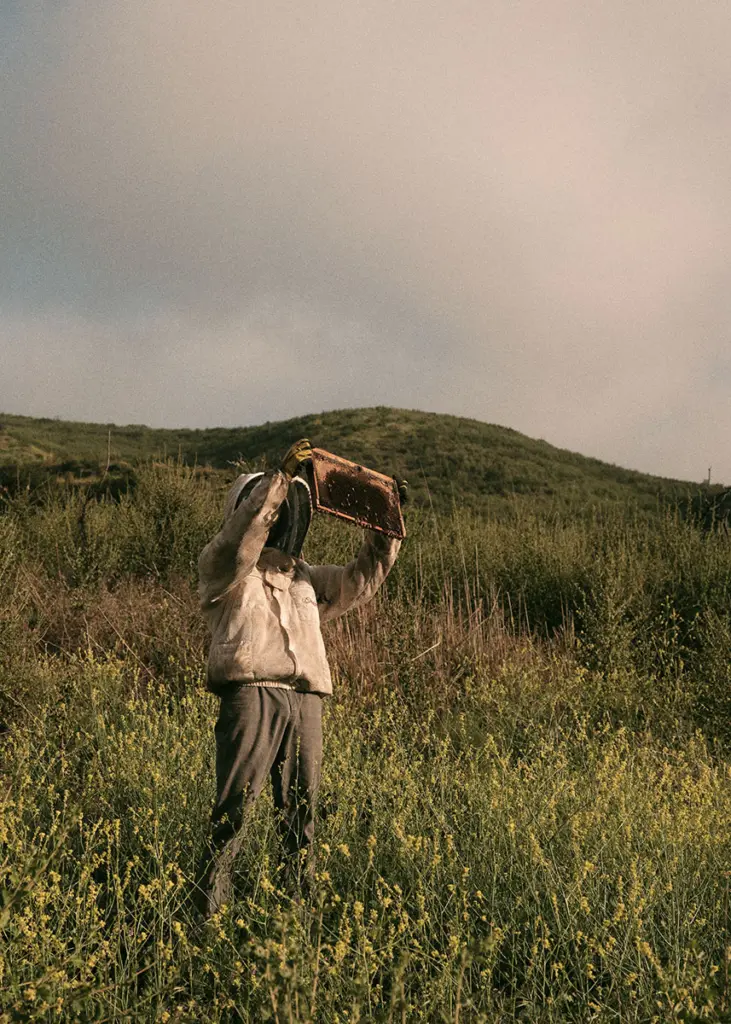
Most of my poems start with an image that I cannot, for whatever reason, shake myself free of. In my day-to-day life I’ll stumble upon a simile or metaphor that surprises me, or a phrase with engaging musicality, and I’ll file it away. I’ve got a small journal I keep on my person at all times that mostly holds disconnected sentences. There’s likewise hundreds of individual notes in my phone containing these images and ideas. If I’m not explicitly attempting to tell a single story in a poem, I’ll draft a poem by going back through months of these notes. I assemble, from these notes, a sequence in a new word document or on a blank page in my main journal. I’ll build on this sequence until the independent images and ideas start to look like a single poem. I’m not an obsessive reviser by default. If I’m happy with how a poem has emerged from its initial drafts, I’m content to let it be and seek out feedback from my trusted readers. For narrative poems, I’m more exhaustive with my revisions. I’ll change the lineation, remove the lineation to work on the poem on the level of the sentence, rearrange scenes, cut and add details, inject music etc. Anything that brings the poem closer to capturing the essence of the story I was hoping to tell. And if the revision process brings a more interesting story to the forefront, or highlights different juxtapositions than I was initially intrigued by, that’s just fine with me. I’m happy as long as I can include striking imagery, engaging musicality, and some expression of the complications of the human heart.
KARAN
Religion moves through your poems with this strange ambivalence. Can we speak about your relationship to/with faith?
ANDREW
I was raised in a religious household, and would have described myself as Christian through my 18th birthday. I struggled, however, with the literal idea of God’s voice. I understood it, back then, as something you should expect to hear as clear as day. I did not hear anything of the sort. When I went to college and was presented with the idea of life without God, I found it liberating and relieving. God’s absence wasn’t some failure of my personal capacity for faith, but just a fact as blunt as a wall. The religious imagination also caused me to develop quite a bit of shame, and I’ve grown towards healthier self-perspective since. My language is suffused with expressions from the Bible, and this is simply a reflection of how I actually speak. I attended Christian schools for most of my childhood, and the Bible was the first literature I consumed. The language of the Bible is rooted in my syntax for keeps. I do like to approach the actual world as a church without walls for human attention, and in this the Biblical language feels appropriate.
KARAN
“Sagittarius A*” is addressed to Lucia, and you’re in Florida while she’s in Denver. “Love I admit I find this distance more believable / than days when we wake up in the same house, in the same life.” Having lived through that kind of distance, that line resonates with me quite strongly. I really love that poem. Love poems are so hard to do well, so when you see them done well, you simply take a bow. Talk to me about love poems? Go in any direction you please!
ANDREW
Love poems are unfairly maligned! When I was first navigating the college workshop environment, I saw other students’ poems torn asunder on a regular basis for daring to be about love. At least once in a poetry class I was discouraged from writing any poem using “love” as a noun. I think maybe that was from Richard Hugo’s The Triggering Town, which is one of my favorite craft books. But I think love is only real subject in poetry. It’s probably the undercurrent of every poem worth reading. You could make the argument that the two subjects of literature are love and death, and I quite prefer “eros and thanatos” over “lyric and narrative” as a framework for understanding poems. My poems never easily fit into the “lyric or narrative” binary, so maybe I’m biased by default. I do think there’s something instructive, when you’re starting out as a poet, in attempting to write poems without defaulting to cliches of love. It’s vastly more interesting to see the minutia of where a young poet is from, and what they’ve spent their life doing in a literal sense. But I’d still argue that the answer to both of those questions, ultimately, falls into the category of love poetry. It’s just a matter of how granularly one presents their particular love.
KARAN
“The Phrase Honest to God Has Always Confused Me” is one of my favorites. “Better to be honest with your postal worker or cashier— / someone who can’t call your bluff and therefore the honesty / means something.” You end by imagining yourself at the foot of the mountain, “worshipping the calf, then drinking its ashes.” There’s such tenderness toward human failure here. How do you write about this failure without falling into either reverence or cynicism?
ANDREW
I feel more intimately familiar with failure than its alternative success. I do think failure is instrumental in the human striving that creates art, and failure possibly drives all progression in human development. We make changes because prior actions have resulted in failure. In this way failure is the engine of much change, positive and negative. As far as writing failure is concerned, I would not know how to position myself as an artist if I felt alienated from failure. I return to the page again and again in part because I don’t believe I fully achieved whatever goal presented itself to me during the prior writing session. Failure paves the way to the next poem, and the next, and the next.
KARAN
You have a license that says “my eyes are green (simplified from hazel).” There’s a heart indicating organ donation. You write, “I suppose I’d rather feed flowers than be a corpse / surrounded by them, a blind man becoming a bed of irises.” Wow! The poems are full of bodies—dead cats, alligators, yellowjackets, composted humans. Is death one of your preoccupations as a poet/thinker?
ANDREW
We’re back to eros v. thanatos! I’m just as likely to conclude a poem with entropy as with love. Artists are working against various forces, but the prevailing force that artists work against is death. It becomes boring, and insincere I think, always deferring to death to make one’s poems heavy with meaning. And yet, death is often where my mind wanders. In literature, death is not merely a destination. It’s also an engine, an inevitability that informs the intensity with which one approaches and makes sense of the world. Death makes love necessary. Joanna Newsom, in the song “Time, as a Symptom,” declares that “love is not a symptom of time; time is just a symptom of love.” I’ve always taken this to mean that death would not weigh so much were we incapable of loving each other and the world. We are inextricable from death, and therefore to love means the world.
KARAN
“If Not Love Proper” meditates on a dead cat on the road and your own cat who “sleeps / on my lap only if there’s a box between us.” You ask, “what’s to say that isn’t a love, / leaving even your body behind as one’s inheritance?” I love how you complicate what counts as love. Not much of segue, but I wanted to speak to you about titles. I am really intrigued by your titles. Do you have a strategy?
ANDREW
Titles are difficult! Jay Hopler, whom I miss dearly, taught me to go seven lines up from the bottom of a poem to find its title. This works more frequently than one might expect. One of the reasons I find it effective is the arbitrary nature of the instruction. Seven lines up is not generally close to the poem’s volta or epiphany. Therefore the image or phrase one might find in the seventh line is possibly more subtly related to the poem’s overall goal. There’s surprise to be found there. I’ve heard the title referred to as a poem’s first or final line, and I do like that gravity. Personally I find myself opting for titles that intrigue and entice, as opposed to summarizing titles.
KARAN
I love “Notes Toward the Great Floridian Novel III”. Hector hauling dead gators to the landfill, the nothing that follows him “putting its / nothing hand out the window in the blistering fetid heat.” That ending—“Nothing that watched always just / below the surface, not even its yellow eyes showing”—is chilling. Are you really working on a novel? (I hope you are!) How do you think about the boundary between poetry and fiction?
ANDREW
I am working on a novel! Slowly, but surely. I am not working on a novel because I think poetry has some deficits that the novel can overcome. But I adore novels. When a novel is really good, it’s the best thing that can be done with the written word. I think the boundary between poetry and fiction is porous. It’s usually easy enough to determine where poetry ends and fiction begins, mostly by looking at the goal of a given piece of writing. Fiction cares about storytelling, and poetry cares about language. But it’s a binary that falls apart with any real scrutiny. Some of my favorite poetry resides in novels written by writers such as Cormac McCarthy, William Faulkner, Toni Morrison, and Karen Russell. And some of my favorite storytelling resides in poems written by Judy Jordan, Brigit Pegeen Kelly, Larry Levis, and Rodney Jones.
KARAN
Colorado and Florida appear throughout as dual homes. You write, “It’s another year I don’t go home / to Florida but instead stay here, my new home, where the trees / are turning the color of maps in library basements.” (Beautiful beautiful!) What does home mean when you’re living between two places? How do these landscapes shape the poems differently?
ANDREW
When I talk about Florida as home, I mean it in a rooted sense. I’m a sixth generation Floridian, and spent most of my childhood and adolescence in the Sunshine State. Colorado is my current residence. Writing about Colorado is mostly discovery. I am still turning over rocks, as it were, and constructing a personal vision of Colorado in poetry. Florida is in my bones. Florida is a place I could write about for the rest of my life and still leave things unmentioned. It’s possibly the most misunderstood state in the union, and has a reputation for being unhinged and populated primarily by criminals. This is partially due to laws in Florida that allow for the immediate publication of criminal charges, which lends the state a certain ungoverned feel. But people are behaving wildly throughout the nation. We just don’t immediately hear about it when a man in Wyoming throws an animal through a drive-through window. When I write about Colorado, I am making a map. I am walking with my hands out in front of me in the dark. When I write about Florida, I am remembering and remembering and remembering. It’s like trying to translate my dreams.
KARAN
Your poems are deeply grounded in the quotidian—apples, mail trucks, driver’s licenses, grocery store cashiers. Yet they keep opening onto the cosmic, the theological, the impossible. How do you move between the mundane and the metaphysical without the seam showing? Give us some craft magic?
ANDREW
I don’t think there’s a difference between the mundane and the metaphysical. There’s no seam in my poems because there’s no seam in the universe. I’m hardly the first person to say it, but the best way to get at the universal is through the personal. So when I’m cataloging the physical objects that comprise my day, my individual way of being in the world, I’m detailing my relationship with the infinite. I think it helps, personally, that I don’t believe in the divine. The sublime exists in the mundane because the mundane is all we have. We’re only our moments taking off our shoes, emptying our pockets to see what’s in there, opening a window to figure out what bird is calling from what tree. It’s everything, love and death and the intersections between them.
KARAN
This is a question we ask all our poets, because the answers are always so wildly different: there’s a theory that a poet’s work tends toward one of four major axes—poetry of the body, poetry of the mind, poetry of the heart, or poetry of the soul. Where would you place your work, if at all?
ANDREW
If forced to choose one, I’m a poet of the body. The body contains the heart, the mind, the soul. The body encompasses one’s imagistic or sensory understanding of the world, from which the metaphorical and associative understandings flow. I’m also a poet of the body because I’ve thought of myself more in terms of the body than in other terms throughout my life. How does this body limit me, how does it fail to measure up, etc. It’s my most immediate framework for looking at myself and by extension the world around me, my various failures and occasional triumphs.
KARAN
What’s the best piece of writing advice you’ve ever received? Alternatively: what would you tell other poets about writing honestly without self-consciousness?
ANDREW
Re: self-consciousness, I think many poets are too precious with the initial compositional process. I’ve gotten to a place with my work where free writing is essential. Discovering the surprising associations and images that I like to feature in my work requires a willingness to let anything that comes naturally have a place on the first page. It’s necessary for me to write down twice as much as I think I might need in the final draft. This allows for a greater ease in revision, a relative lack of concern regarding where the poem came from and where it’s going. To the self-conscious writer: no one needs to ever see your notes! Write the sloppiest, most overblown thing you can manage to write. Then whittle it down. The final draft is all your readers will ever see. The other thing I would strongly recommend to any poet: keep track of your drafts. I still over-revise drafts from time to time, and it’s comforting being able to revert to a draft from months prior if the current progression of the revision process feels unproductive or stymied in some way.
KARAN
Would you offer our readers a poetry prompt—something simple, strange, or rigorous—to help them begin a new poem?
ANDREW
This one helps me kickstart a draft if I’m struggling. Write ten clean sentences about your topic or story. Each sentence must have a different subject. I like this one because the subject restriction forces you to look in different corners of a scene for imagery. Richard Hugo wrote about a similar rule in The Triggering Town. Varying your subjects keeps the poetic eye moving, and can increase the dynamic feeling of a draft.
KARAN
Please recommend a piece of art (a film, a song, a painting, anything other than a poem) that’s sustained you lately or that you wish everyone could experience.
ANDREW
My parents are in the process of moving to Santa Fe, NM. As such I usually make the trip south from Denver once a year. The Georgia O’Keefe Museum is in Santa Fe, and I make a point to go every time I’m in town. There’s so many painting by O’Keefe that I could highlight here. I am tentatively planning an ekphrastic series in response to her work. I keep a small postcard featuring Black Mesa Landscape, New Mexico / Out Back of Marie’s II on my bedroom bookshelf, so I’ll highlight that one. The vaulting softness of the landscape, the color gradient. It’s just stunning.
KARAN
And finally, Andrew, since we believe in studying masters’ masters, who are the poets or artists who’ve most shaped your sense of what’s possible in language?
ANDREW
I try to make note of each book that immediately changes my goals in language. If I read a book that forces me to reassess what I want to accomplish in poetry, it goes on the list. Some of these poets have been my teachers, and some are just invaluable influences.
-Jay Hopler, Green Squall
-Judy Jordan, Carolina Ghost Woods
-Larry Levis, Winter Stars
-Brigit Pegeen Kelly, Song
-Ross Gay, Catalogue of Unabashed Gratitude
-Carl Phillips, Pale Colors in a Tall Field
-Ed Skoog, Run the Red Lights
-Lucie Brock-Broido, Stay, Illusion
-Diane Seuss, Frank: Sonnets
-Joanna Klink, The Nightfields
RECOMMENDATIONS
Black Mesa Landscape, New Mexico / Out Back of Marie’s II at the Georgia O’Keefe Museum in Santa Fe
POETRY PROMPT
Write ten clean sentences about your topic or story. Each sentence must have a different subject. I like this one because the subject restriction forces you to look in different corners of a scene for imagery. Richard Hugo wrote about a similar rule in The Triggering Town. Varying your subjects keeps the poetic eye moving, and can increase the dynamic feeling of a draft.





%20by%20August%20(A%CC%81gost)%20Canzi%20(1856).png)


.avif)