John's Table by Lesle Lewis
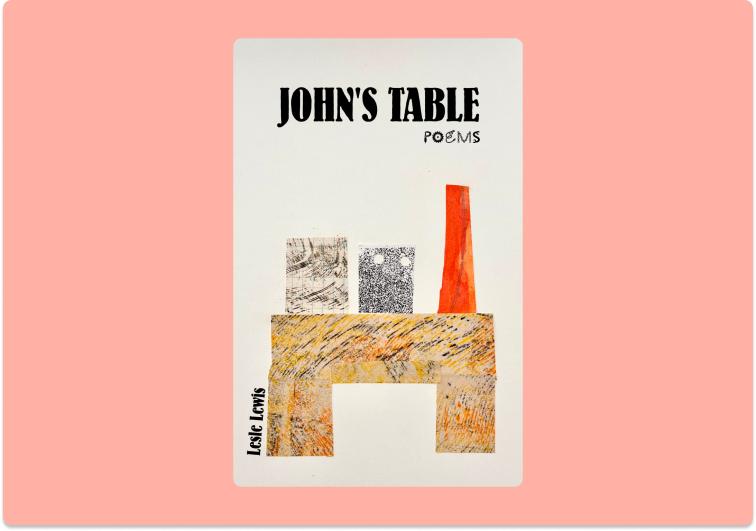
I’m sitting on my front porch. Four boys bike-ride by on their way to their last day of school ahead of summer break. Three boys wear helmets and pedal on the sidewalk. One boy wears no helmet—his only skull and child-brain exposed to the elements, weather like wind, danger like concrete—and rides his bike in the street.
This is what John’s Table, the sixth full-length collection from Lesle Lewis, feels like: a bridge between danger and safety, a curiosity towards both, somehow, a sideways glance between a You and I who meet in a We.
The You and I of John’s Table orbit one another, sometimes in a parking lot, sometimes on a road trip, sometimes in a kitchen:
“Quiet please,” the sign says.
“Friendly,” I say.
“Not friendly,” you reply.
Lewis’s perception of both realities does not force a decision about who might be right or wrong. Rather, she asks us to live in the in-between void of a conversation without agreement.
Though it’s not only danger and safety that we’re straddling; it’s a desire to be awed with a weariness of all this color:
We see everything.
Behind Walgreens for example.
We’re not wowed by it.
All of those photos of sunsets I’ve taken in the parking lots of shopping malls and convenience stores, my brief moments of dazzle followed by my slumped shoulders of sadness. Is it that nothing can capture the magnitude or is it that something can capture the magnitude but it will take a long time and I’m worried I don’t or won’t have enough of it? Or is it that, as Lewis posits, that:
No one taught us how.
No one taught us how to be not only wowed but how to:
…put our arms around each other.
That might be it: that the ability to be wowed lives in the arms of one another. In this way, we become a We: reader, speaker? The You and I? The actual you and I? Poet and whoever poet writes poems for, our greatest mystery of our great universe? A poem near the heart—I mean, center—of John’s Table starts:
What we pull from the air has authority.
But later, after many refrains, many mantras, continues:
And when I say I have a feeling, I mean that I have an idea to feel calm.
The poem, called “Light,” encapsulates what John’s Table accomplishes throughout its pages, not with reverie but with the posture of a fabulously upright animal: the creation of principles that read like the Tao kissed the face of a mother’s thoughts.
As I flip through John’s Table, I rediscover, typically, an accidental bookmark I must’ve tucked into its pages while tidying without throwing anything away: a “Fortune Teller Miracle Fish.” The packaging is red and slim, slippery plastic. Inside the slight sleeve, a bright red, translucent fish that curls or flips in the palm of a hand, depending on mood, depending on the future of the hand itself.
This is also what John’s Table feels like: a container for a future, a fortune we’re told that remains open for our own interpretation, a prediction that feels less like certainty and more like a riddle. The edge of now and beyond lives, I can see now, through Lewis’s works, at the table itself.
A few poems after Light, Lewis actually notes the center—the heart—of the collection, breaking whatever fourth call can exist for a book of mundanity’s mantras:
Mary rings the dinner gong.
We will have a bit more time together.
I’ll puzzle it out in the end.
The poems in John’s Table help me choose to believe Lewis, for this collection or beyond, that she can and will, in fact, puzzle it out in the end. Lewis writes, buried in the core, like a collection of worms with an apple in the center:
You want an oblivious beautiful life?
Give it a go.
The puzzle will require a tractor and laughing our heads off. I close John’s Table and wonder who I’d hand my head to.